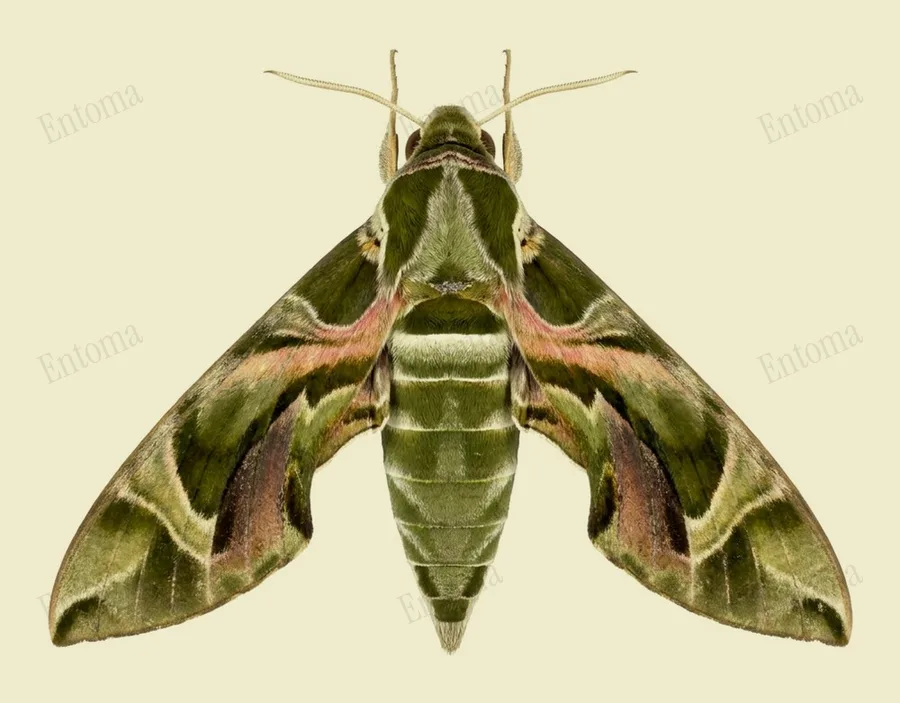
Oleander hawkmoth
This moth's caterpillars feed on oleander, a plant poisonous enough to harm most animals, and store its toxins in their bodies to become poisonous themselves.
| Where | Gardens, scrubland and open parks |
|---|---|
| Size | 85 to 125 mm wingspan |
| When | January to December |
The Oleander hawkmoth is a large moth with dark green forewings marked by pale streaks and swirling patterns, and a stout, tapering body. Its head and thorax carry an olive green and rufous pattern that continues the camouflage of the wings.
Caterpillars feed on oleander and related plants, absorbing the toxins these plants contain without harm to themselves, which makes the caterpillars unpalatable to birds. Adults fly at dusk and after dark, hovering before scented flowers such as jasmine and honeysuckle to feed.
Traits
Habitat
Garden
Colour
Green, White, Brown
Active
Night
To people
Mild
Adults do not bite or sting and feed only on nectar after dark; caterpillars are toxic if eaten, having taken up poisons from the oleander they feed on.
Activity through the year
Often confused with
The Jade hawkmoth is darker overall, with a purplish brown head and collar, and shows a white spot at the forewing tip that the Oleander hawkmoth lacks.
Questions
Is the Oleander hawkmoth dangerous to people?
Mild. Adults do not bite or sting and feed only on nectar after dark; caterpillars are toxic if eaten, having taken up poisons from the oleander they feed on.
When can you see the Oleander hawkmoth?
The Oleander hawkmoth can be seen from January to December, at night.
Plate retouched from a museum specimen photo by PlutoF Platform, Estonian Museum of Natural History, CC BY 4.0, GBIF Licence
Report a mistake in this entry
Butterflies and moths›Hawk moths›Daphnis
Last updated 2026-09-27. Every entry is checked against published sources.