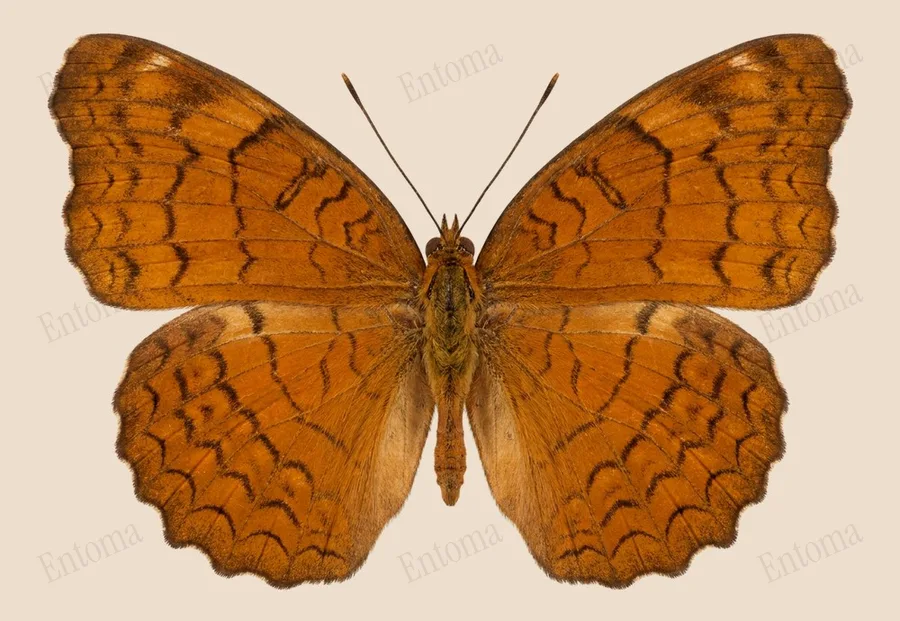
Angled castor
Its caterpillars forcefully eject their frass pellets away from the body at every larval stage, a defense against parasites that hunt by scent.
| Where | Waste ground, scrub and forest edges |
|---|---|
| Size | 38 to 45 mm wingspan |
| When | May to February |
The Angled castor is orangey to reddish brown above, crossed by several narrow, wavy black lines, with a small white spot near the forewing tip. The hindwing margin is deeply scalloped, giving the wings their angled outline, and the underside is pale crimson brown with irregular darker bands.
Adults fly low and slowly, visiting grass flowers and puddling at damp mud. Caterpillars feed on the castor oil plant and on wild Tragia vines, spinning a slender pupa that hangs rigidly by the tail.
Traits
Habitat
Farmland
Colour
Orange, Brown, Black
Active
Day
To people
Not known to sting or bite; feeds at flowers and damp mud without bothering people.
Activity through the year
Often confused with
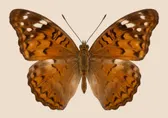
Common castor has broader, more diffuse transverse bands that form a continuous, uninterrupted line on the hindwing, while the Angled castor's bands are narrower and its hindwing margin more sharply angled.
Questions
Is the Angled castor dangerous to people?
Not known to sting or bite; feeds at flowers and damp mud without bothering people.
When can you see the Angled castor?
The Angled castor can be seen from May to February, by day.
Plate retouched from a museum specimen photo by Swiss Natural History Collections - SwissNatColl, CC BY 4.0, GBIF Licence
Report a mistake in this entry
Butterflies and moths›Brush-footed butterflies›Ariadne
Last updated 2026-09-27. Every entry is checked against published sources.