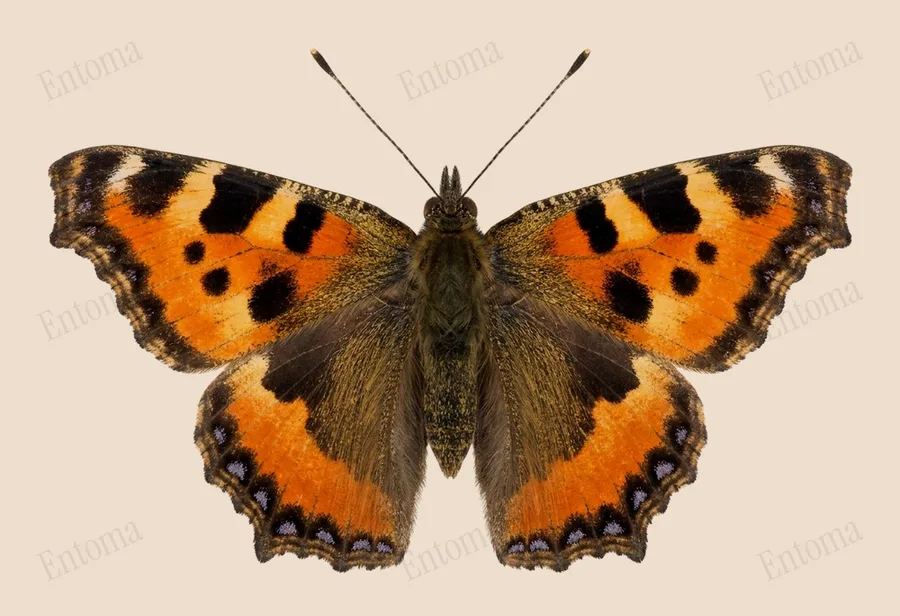
Indian tortoiseshell
This tortoiseshell survives winter as a hibernating adult at high elevation, then reappears on the wing as soon as the mountain slopes begin to warm.
| Where | Mountain meadows and forest edges |
|---|---|
| Size | 52 to 63 mm wingspan |
| When | January to December |
The Indian tortoiseshell has pale brown and yellow forewings and red-tinged hindwings, its underside closely set with short dark transverse streaks and crossed by a sinuous pale blue band near the margin.
It flies over mountain meadows and forest edges at elevations from about 600 to 5500 metres, basking on bare ground or rock and overwintering as an adult through the coldest months.
Traits
Habitat
Grassland
Colour
Yellow, Red, Brown
Active
Day
To people
Does not sting or bite; visits flowers and can often be seen basking on bare rock in the sun.
Activity through the year
Often confused with
Ladakh tortoiseshell has a convex, not pointed, forewing margin and a paler underside with fewer dark markings than the Indian tortoiseshell.
Rizana tortoiseshell is smaller and more compact, with the forewing apex less drawn out than in the Indian tortoiseshell.
Questions
Is the Indian tortoiseshell dangerous to people?
Does not sting or bite; visits flowers and can often be seen basking on bare rock in the sun.
When can you see the Indian tortoiseshell?
The Indian tortoiseshell can be seen from January to December, by day.
Plate retouched from a photo by Ramnarayan K, CC BY 4.0, iNaturalist Licence
Report a mistake in this entry
Butterflies and moths›Brush-footed butterflies›Aglais
Last updated 2026-09-27. Every entry is checked against published sources.