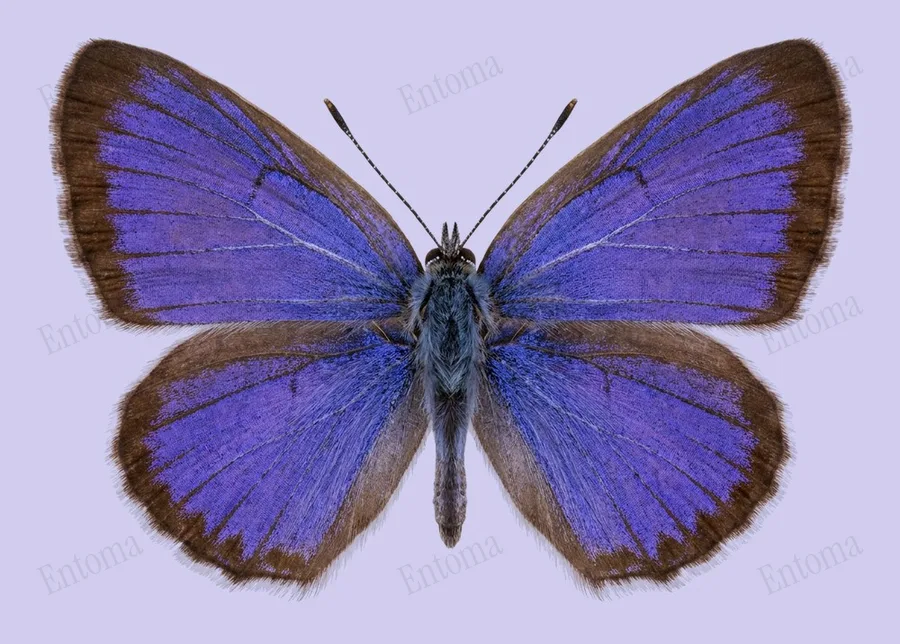
Common ciliate blue
Its caterpillars depend entirely on weaver ants for protection, trading sugary secretions from special pore organs for round the clock bodyguards.
| Where | Gardens, parks and forest edges |
|---|---|
| Size | 23 to 30 mm wingspan |
| When | January to December |
The common ciliate blue is a small lycaenid; males are dark purplish blue above with narrow black borders, while females are brown with paler discal areas and iridescent blue patches at the wing bases. Short, fine tails extend from veins 1b, 2 and 3 on the hindwing, giving the ciliated edge that names the species.
Caterpillars feed on the young leaves of several unrelated plants, including yellow saraca and golden shower, and live in an obligate partnership with weaver ants that guard them in exchange for appeasement secretions. Adults have a rapid, erratic flight, and males puddle on damp footpaths.
Traits
Habitat
Towns
Colour
Blue, Brown
Active
Day
To people
Males puddle on damp footpaths but are not known to bother people.
Activity through the year
Often confused with
Very similar, but with a distinctly narrower, more pointed forewing tip and a hindwing corner that comes to a sharper angle, plus an underside discal band broken into a Y shape rather than a single continuous line.
Questions
Is the Common ciliate blue dangerous to people?
Males puddle on damp footpaths but are not known to bother people.
When can you see the Common ciliate blue?
The Common ciliate blue can be seen from January to December, by day.
Plate retouched from a museum specimen photo by Finnish Museum of Natural History - Zoology Unit, CC BY 4.0, GBIF Licence
Report a mistake in this entry
Butterflies and moths›Blues and coppers›Anthene
Last updated 2026-09-27. Every entry is checked against published sources.