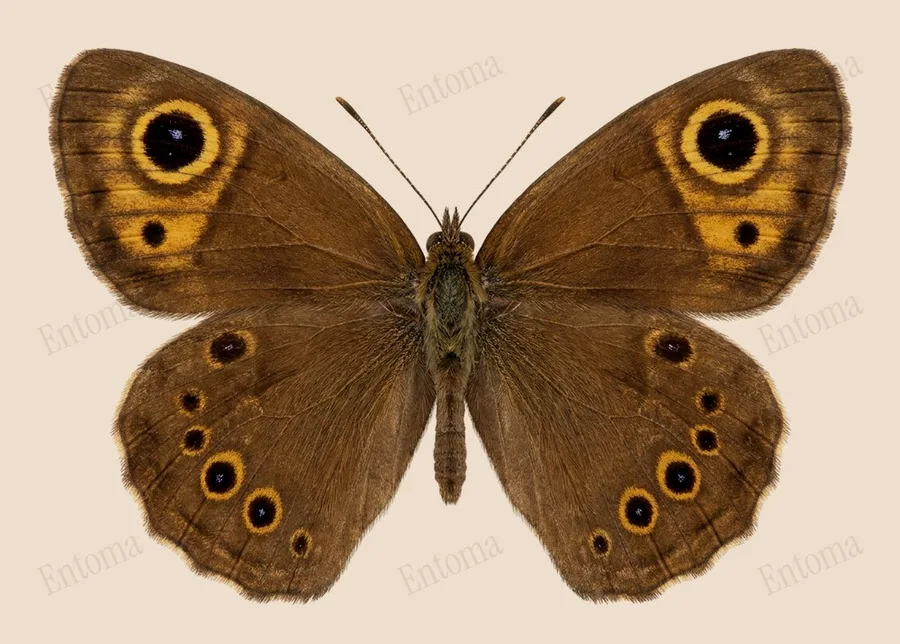
Common four-ring
The common four-ring gets its name from the four yellow-ringed eyespots on its hindwing underside, one fewer than its five-ringed relative.
| Where | Open grassy patches and forest edges |
|---|---|
| Size | 30 to 39 mm wingspan |
| When | January to December |
The common four-ring is a small, greyish brown satyrid with a large twin-pupilled, yellow-ringed eyespot near the forewing tip and, on the underside hindwing, four smaller yellow-ringed eyespots arranged in a gentle curve; fine dark striae cross the pale grey-brown underside.
Caterpillars feed on lawn and roadside grasses such as Bermuda grass and other low grasses, and the adults fly with a weak, jerky flight low over grassy ground, resting with wings closed for long spells before opening them fully to bask in the sun.
Traits
Habitat
Grassland
Colour
Brown, Yellow
Active
Day
To people
Not known to bite or sting people.
Activity through the year
Often confused with
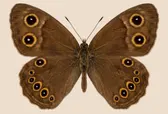
Usually shows five yellow-ringed eyespots on the hindwing underside, including one extra spot the common four-ring never has, giving the two species their names.
Questions
Is the Common four-ring dangerous to people?
Not known to bite or sting people.
When can you see the Common four-ring?
The Common four-ring can be seen from January to December, by day.
Plate retouched from a museum specimen photo by Swiss Natural History Collections - SwissNatColl, CC BY 4.0, GBIF Licence
Report a mistake in this entry
Butterflies and moths›Brush-footed butterflies›Ypthima
Last updated 2026-09-27. Every entry is checked against published sources.