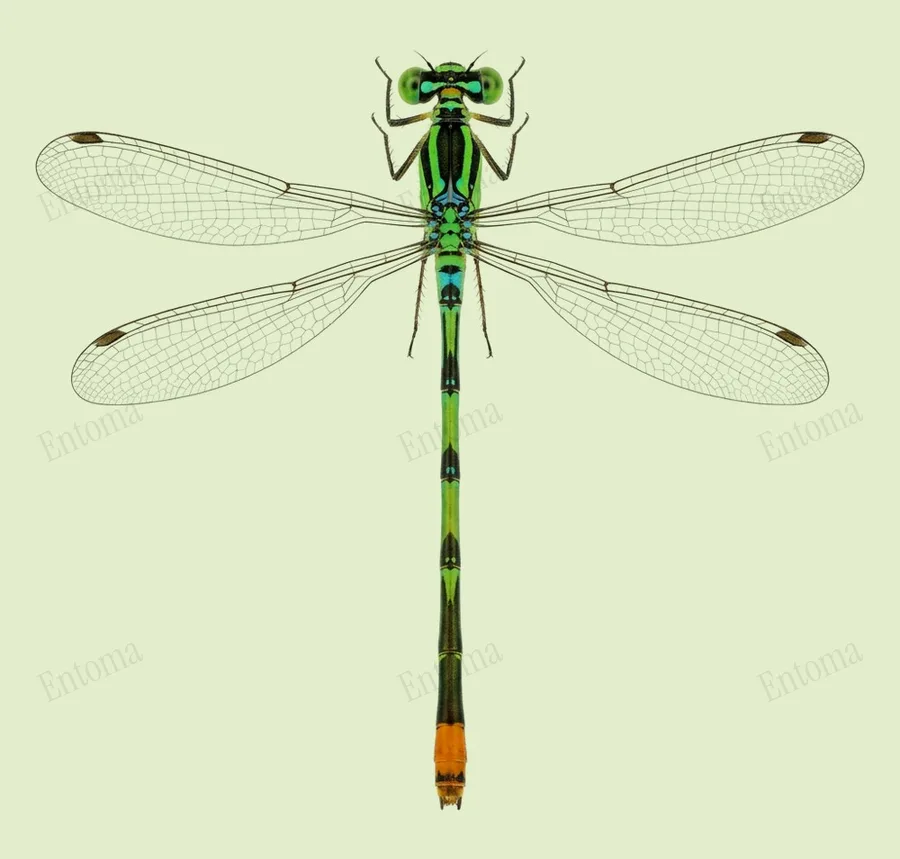
Wandering midget
Wandering midget males develop a snowy white waxy coating as they age, gradually obscuring the green and black pattern seen in young adults.
| Where | Marshes, ponds and wet grassland |
|---|---|
| Size | 16 to 18 mm abdomen length |
| When | January to December |
The wandering midget is a tiny damselfly with black-capped green eyes and a black thorax striped with apple green; the male's abdomen is black above and pale green below on the first seven segments, with the last few segments bright orange red, while older males develop a white waxy bloom that can obscure these markings.
Females occur in several colour forms, from a mostly green pattern to a red form and forms that mimic the male's colouring, and both sexes breed in marshes, ponds and other still water, staying low over grass and flying only weakly and briefly at a time.
Traits
Habitat
Wetland
Colour
Green, Black, Orange
Active
Day
To people
Not known to bite or sting people.
Activity through the year
Often confused with
Overall pale blue to white in colour with restricted black markings, rather than the wandering midget's green and black pattern with an orange-red abdomen tip.
Questions
Is the Wandering midget dangerous to people?
Not known to bite or sting people.
When can you see the Wandering midget?
The Wandering midget can be seen from January to December, by day.
Plate retouched from a museum specimen photo by Philip Lewis, Australian Museum, CC BY 4.0, GBIF Licence
Report a mistake in this entry
Dragonflies and damselflies›Narrow-winged damselflies›Agriocnemis
Last updated 2026-09-27. Every entry is checked against published sources.