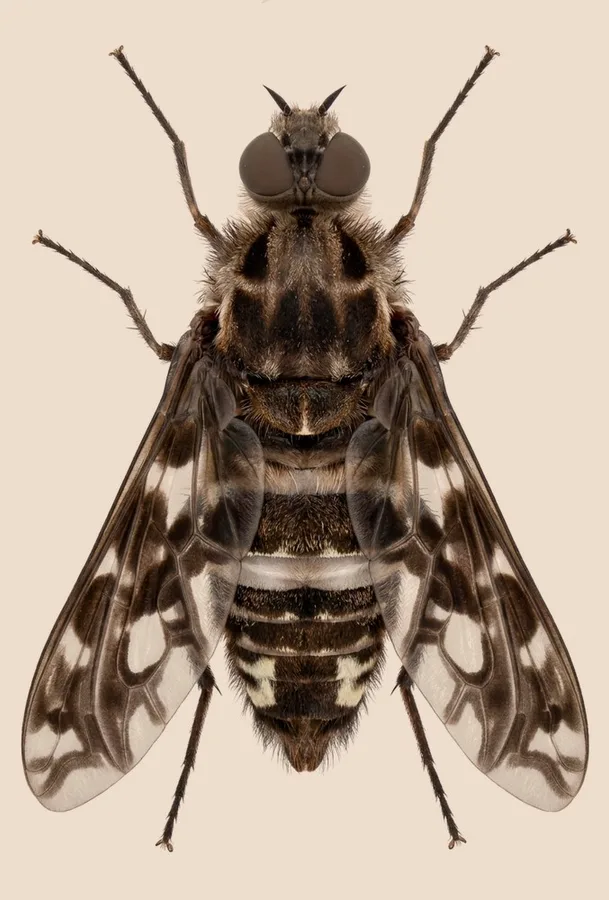
Tiger bee fly
This large fly cannot sting or bite at all, yet its size and hovering flight are often enough to convince onlookers it is a bee.
| Where | Near wooden buildings and fences |
|---|---|
| Size | 11 to 19 mm body length |
| When | June to August |
The Tiger bee fly is a stout, black-bodied fly reaching about 11 to 19 mm long, with two small white spots on the abdomen and wings marked with bold, irregular black patches. Despite its bee-like size and hovering flight, it has only one pair of functional wings and cannot sting or bite.
Females hover near old wood and fence posts riddled with carpenter bee tunnels, laying eggs close to the entrances rather than inside them. The larvae that hatch crawl in and feed on the developing carpenter bee grubs, and adults are seen at flowers through summer near the nests they depend on.
Traits
Habitat
Towns
Colour
Black, White
Active
Day
To people
Cannot sting or bite; harmless to people despite its bee-like appearance.
Activity through the year
Often confused with
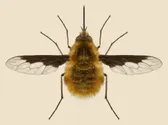
Smaller and rounder, with wings shaded dark only across the front half rather than the bold, irregular tiger-striped pattern of the Tiger bee fly.
Questions
Is the Tiger bee fly dangerous to people?
Cannot sting or bite; harmless to people despite its bee-like appearance.
When can you see the Tiger bee fly?
The Tiger bee fly can be seen from June to August, by day.
Plate retouched from a photo by Alie / C.A. Kratzer, CC BY‑SA 4.0, iNaturalist Licence
The plate on this page is shared under the same licence as its source, CC BY-SA.
Report a mistake in this entry
Last updated 2026-09-26. Every entry is checked against published sources.