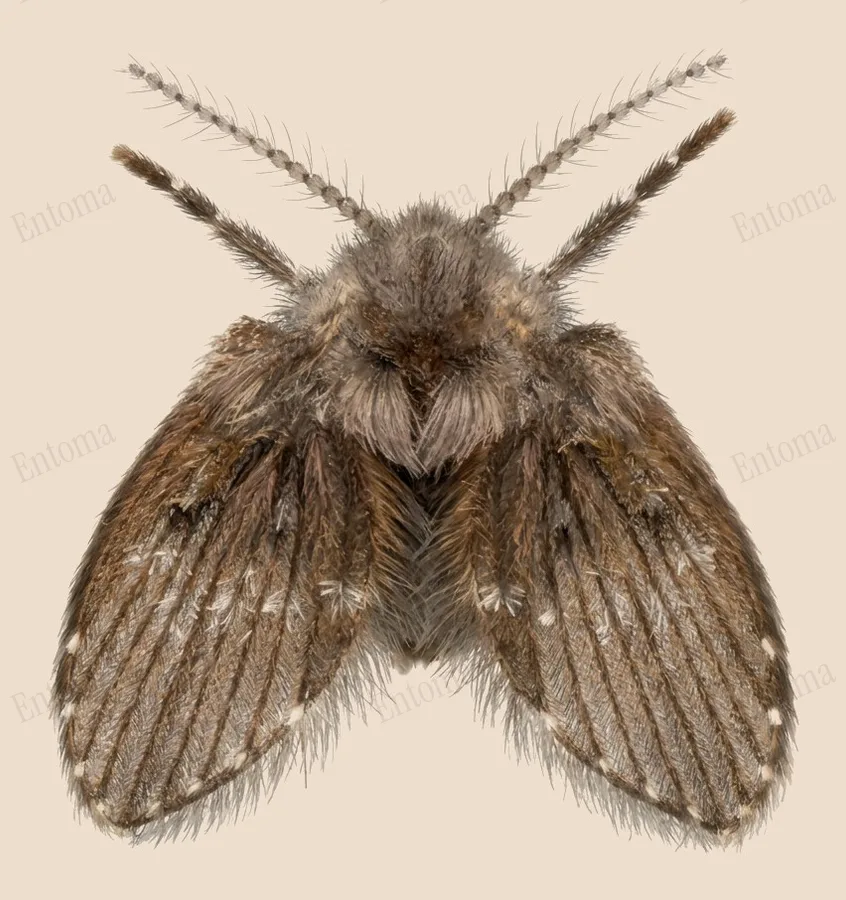
Bathroom moth fly
This insect is a true fly, not a moth, and its larvae live inside the slimy biofilm that lines shower and floor drains.
| Where | Drains and damp organic matter |
|---|---|
| Size | 3 to 5 mm body length |
| When | May to November |
The bathroom moth fly is small and stocky, covered from head to wingtip in dense grey brown hair that gives it a fuzzy, moth-like look. Its broad, pointed wings are often marked with faint pale spots near the tips and are held roof-like over the body at rest, while weak, fluttering flight and short antennae give it away as a true fly rather than a moth.
Larvae live inside the gelatinous film that builds up in sink, shower, and floor drains, feeding on bacteria and decaying organic matter for two to three weeks before pupating; the short-lived adults that follow are most active after dark and are often found resting on bathroom walls close to water.
Traits
Habitat
Towns
Colour
Grey, Brown, White
Active
Night
To people
It does not bite or sting; large numbers around a drain are a nuisance rather than a health concern, and getting rid of them means clearing out the organic film they breed in.
Activity through the year
Often confused with
Psychoda alternata is a similar size at about 2 to 5 mm long, but it holds its wings flatter and at a sharper angle from the body, and is most often linked with sewage treatment works rather than household drains.
Questions
Is the Bathroom moth fly dangerous to people?
It does not bite or sting; large numbers around a drain are a nuisance rather than a health concern, and getting rid of them means clearing out the organic film they breed in.
When can you see the Bathroom moth fly?
The Bathroom moth fly can be seen from May to November, at night.
Plate retouched from a photo by Chase G. Mayers, CC BY 4.0, Wikimedia Commons Licence
Report a mistake in this entry
Last updated 2026-09-26. Every entry is checked against published sources.