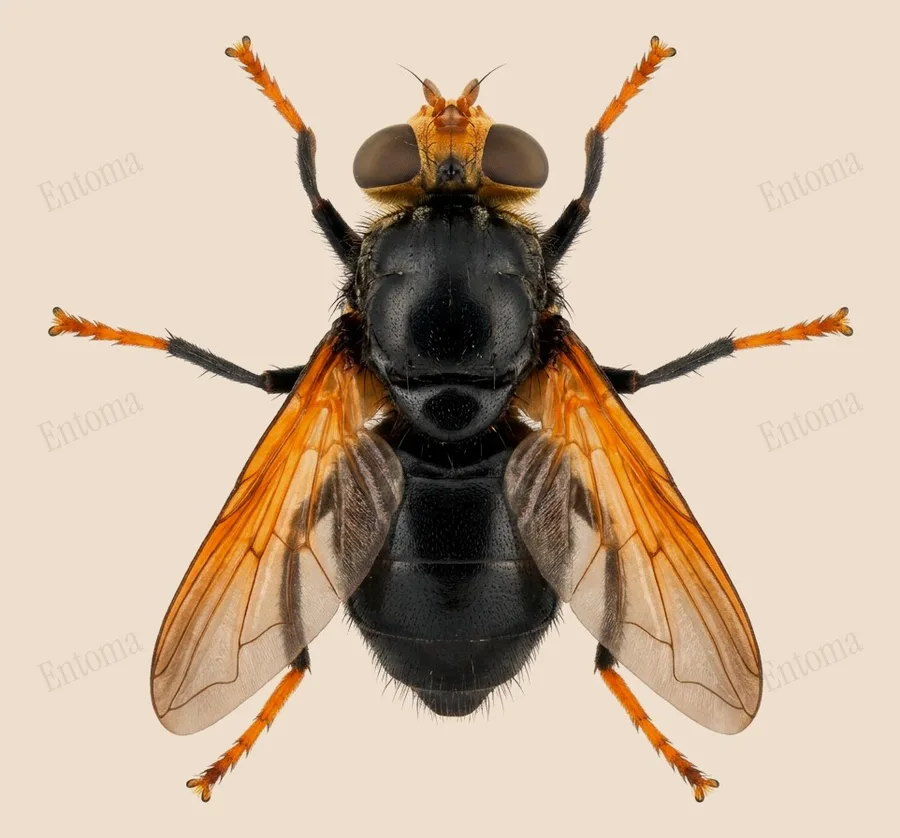
Noon fly
The Noon Fly gets its warm-sounding name from basking in full sun around the middle of the day, between visits to dung and flowers.
| Where | Woodland edges, hedgerows and pastures |
|---|---|
| Size | 9 to 13 mm body length |
| When | April to November |
The Noon Fly is a large, jet-black fly with a dense covering of black hair, set off by patches of warm orange-gold at the base of the wings, on the feet and on the face.
Adults bask on sunlit leaves, fence posts and tree trunks in wooded, well-vegetated countryside, often near grazing cattle, and visit flowers such as ivy for nectar. Larvae develop in cow and horse dung, keeping the adults close to livestock.
Traits
Habitat
Farmland
Colour
Black, Orange
Active
Day
To people
Harmless to people; adults feed on nectar and simply bask in the sun near livestock.
Activity through the year
Often confused with
It has a bright metallic green body all over, lacking the jet-black colour and orange-gold wing bases, feet and face of the Noon Fly.
Questions
Is the Noon fly dangerous to people?
Harmless to people; adults feed on nectar and simply bask in the sun near livestock.
When can you see the Noon fly?
The Noon fly can be seen from April to November, by day.
Plate retouched from a photo by Emanuele Santarelli, CC BY‑SA 4.0, iNaturalist Licence
The plate on this page is shared under the same licence as its source, CC BY-SA.
Report a mistake in this entry
Last updated 2026-09-26. Every entry is checked against published sources.