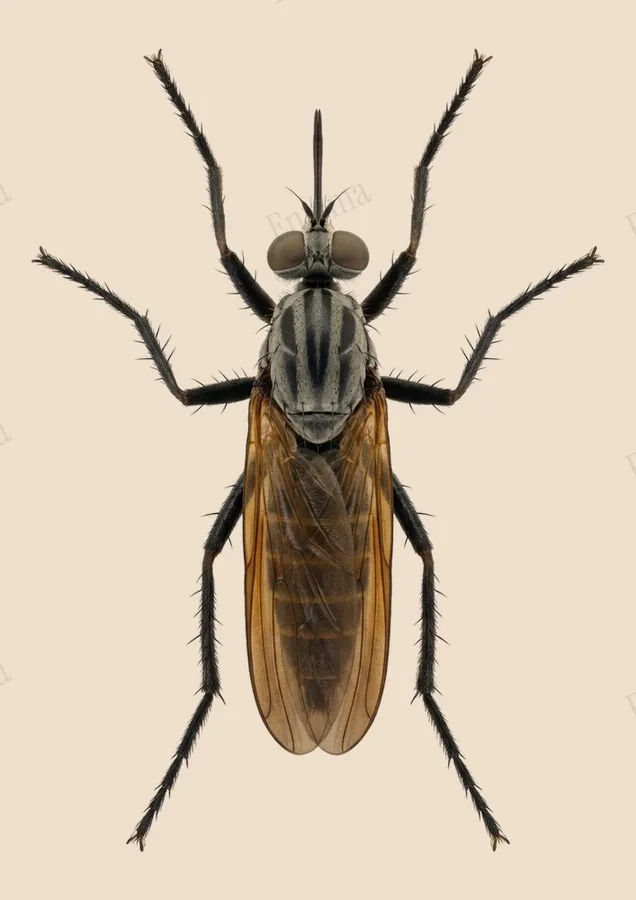
Tessellated dance fly
This fly hunts other flying insects with a long, forward-pointing proboscis, yet adults also visit hogweed and other umbellifer flowers to feed on nectar.
| Where | Damp meadows and woodland edges |
|---|---|
| Size | 9 to 11 mm body length |
| When | April to June |
The tessellated dance fly is a large, bristly dance fly with a strongly black body, long red-yellow legs with black thighs, and brownish wings with dark veins and a rusty-yellow leading edge. A long, forward-pointing proboscis is used to pierce prey.
Adults hunt other flying insects, piercing them with the proboscis to feed, and are commonly seen visiting hogweed and other umbellifer flowers in damp meadows and woodland edges during late spring.
Traits
Habitat
Grassland
Colour
Black, Brown
Active
Day
To people
Preys on other insects, not people; it does not bite or bother humans.
Activity through the year
Often confused with
A similar hunting fly, but it has a brown thorax with three dark stripes and red-orange legs rather than the strongly black body of the tessellated dance fly.
Questions
Is the Tessellated dance fly dangerous to people?
Preys on other insects, not people; it does not bite or bother humans.
When can you see the Tessellated dance fly?
The Tessellated dance fly can be seen from April to June, by day.
Plate retouched from a photo by Jamie O'Neill, CC BY 4.0, iNaturalist Licence
Report a mistake in this entry
Last updated 2026-09-26. Every entry is checked against published sources.