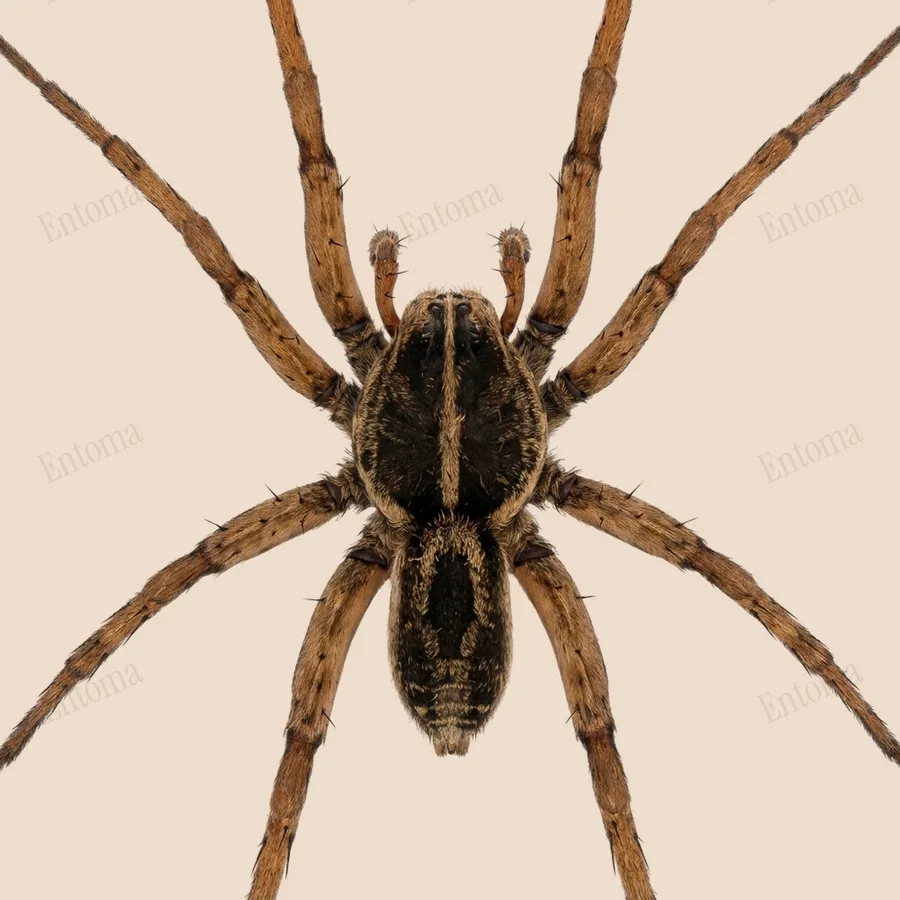
Wetland giant wolf spider
This burrow-dwelling wolf spider hunts without a web, and females carry their egg sac on their spinnerets until it hatches, then carry the spiderlings on their back.
| Where | Wet woods, marshes and fields |
|---|---|
| Size | Female up to 21 mm, male about 12 mm body length |
| When | March to October |
The wetland giant wolf spider is a large, robust hunter with a brown carapace marked by a bold yellow stripe running from its eyes back across the head, and black spots on the underside of the abdomen. Females are noticeably larger than males, with reddish brown legs, while males have plain yellow legs.
It hunts by ambush rather than by web, often sheltering under a stone or board near water and waiting nearby for passing prey. Found in wet woods, marshes and grassy fields across the eastern half of the United States and into southern Canada and Mexico, it hunts mainly at night and is often noticed in autumn, when it wanders into buildings seeking shelter.
Traits
Habitat
Wetland
Colour
Brown, Yellow, Black
Active
Night
To people
This large wolf spider is not aggressive and rarely bites people; it is not dangerous to have around, even though its size looks intimidating.
Activity through the year
Often confused with
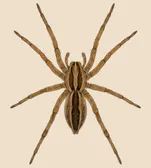
Shows a row of slanted pale tan or orange spots along the abdomen and pale eyebrow-like marks behind the eyes, rather than the solid yellow stripe down the head and black-spotted underside of the wetland giant wolf spider.
Questions
Is the Wetland giant wolf spider dangerous to people?
This large wolf spider is not aggressive and rarely bites people; it is not dangerous to have around, even though its size looks intimidating.
When can you see the Wetland giant wolf spider?
The Wetland giant wolf spider can be seen from March to October, at night.
Plate retouched from a photo by Stephanie Dolrenry, CC BY‑SA 4.0, iNaturalist Licence
The plate on this page is shared under the same licence as its source, CC BY-SA.
Report a mistake in this entry
Last updated 2026-09-27. Every entry is checked against published sources.