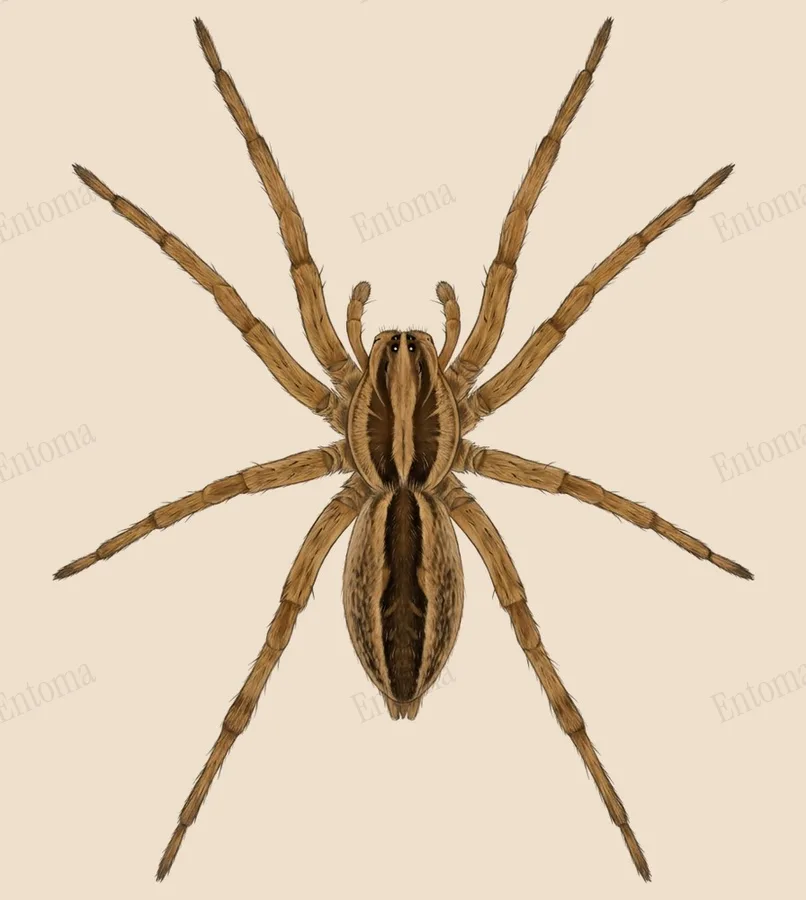
Rabid wolf spider
Despite its alarming name, this spider has nothing to do with rabies; the name only describes its fast, erratic dash when disturbed.
| Where | Wooded areas, fields and leaf litter |
|---|---|
| Size | Female 16 to 21 mm, male 12 to 13 mm body length |
| When | March to October |
This wolf spider has a dark gray brown cephalothorax with two pale longitudinal stripes and an abdomen marked with a dark central band and pale spots toward the rear. Males have distinctly blackened front legs, and females, at 16 to 21 mm, are noticeably larger than the 12 to 13 mm males.
It runs down insect prey rather than trapping it in a web, hiding by day in leaf litter, burrows or under debris and hunting mainly after dark. The female carries a round, pale blue egg case about the size of a pea until the young are ready to disperse.
Traits
Habitat
Woodland
Colour
Brown, Grey
Active
Night
To people
Mild
This spider can bite if handled, causing brief local pain and swelling similar to a bee sting, but it is not dangerous to people and is not linked to rabies in any way.
Activity through the year
Often confused with
Marked with pale spots rather than the rabid wolf spider's plain dark central stripe, and its males lack the blackened front legs seen on male rabid wolf spiders.
Questions
Is the Rabid wolf spider dangerous to people?
Mild. This spider can bite if handled, causing brief local pain and swelling similar to a bee sting, but it is not dangerous to people and is not linked to rabies in any way.
When can you see the Rabid wolf spider?
The Rabid wolf spider can be seen from March to October, at night.
Plate retouched from a photo by schoenitz, CC0, iNaturalist Licence
Report a mistake in this entry
Last updated 2026-09-27. Every entry is checked against published sources.