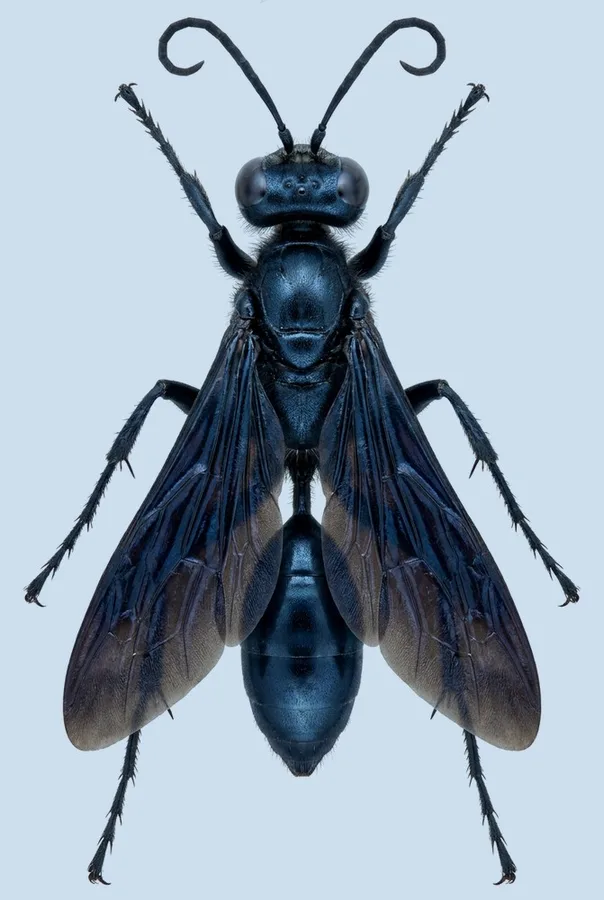
Great black digger wasp
A female Great black digger wasp digs her own nest burrow and stings grasshoppers or katydids to paralyze them alive as food for a single larva.
| Where | Open fields, gardens and meadows |
|---|---|
| Size | 20 to 38 mm body length |
| When | July to September |
The Great black digger wasp is a large, thread-waisted wasp with a satiny black body and smoky wings that shine with blue iridescence, long spiny legs and large, sickle-shaped jaws. Females measure up to about 38 mm, noticeably larger than males, which lack a stinger entirely.
Each female digs a burrow in bare or sparsely vegetated soil, then hunts grasshoppers, crickets and katydids, stinging each one to paralyze it before dragging it below ground as food for a single larva. Adults themselves feed only on nectar and pollen, and this solitary wasp keeps no colony or nest to defend.
Traits
Habitat
Grassland
Colour
Black, Blue
Active
Day
To people
Mild
Females can sting if grabbed or trapped, though the sting is not from nest defense since this solitary wasp keeps no colony.
Activity through the year
Often confused with
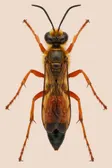
Similarly large and thread-waisted, but has reddish orange on the front part of the body and legs instead of the all-black body of the Great black digger wasp.
A much smaller, slender wasp with a solid metallic blue-black body and a thinner thread-like waist than the larger, plain black Great black digger wasp.
Questions
Is the Great black digger wasp dangerous to people?
Mild. Females can sting if grabbed or trapped, though the sting is not from nest defense since this solitary wasp keeps no colony.
When can you see the Great black digger wasp?
The Great black digger wasp can be seen from July to September, by day.
Plate retouched from a museum specimen photo by Davidson College, CC0, GBIF Licence
Report a mistake in this entry
Bees, wasps and ants›Thread-waisted wasps›Sphex
Last updated 2026-09-27. Every entry is checked against published sources.