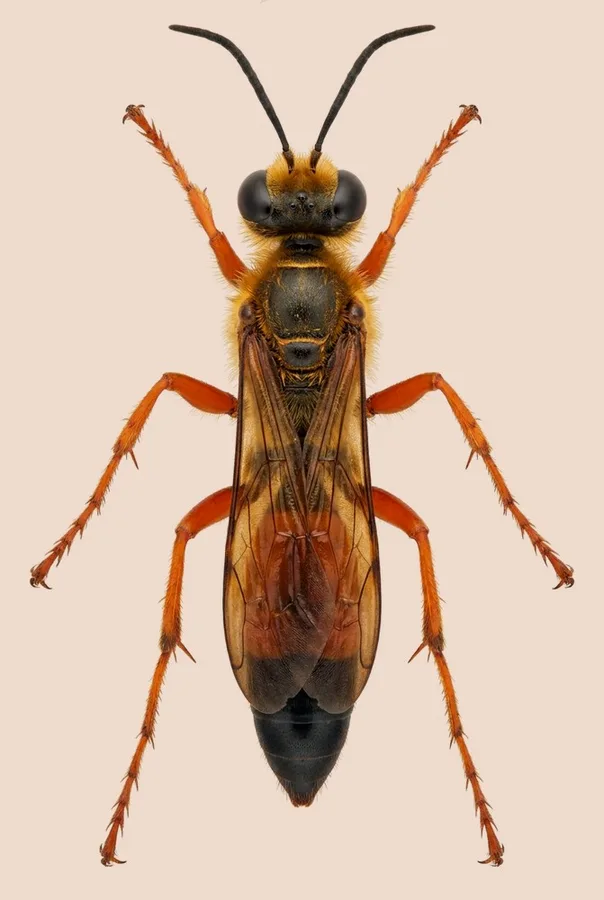
Great golden digger wasp
This solitary wasp paralyzes a katydid with a sting, then drags the still-living prey into an underground burrow to feed a single larva.
| Where | Open sandy ground across North America |
|---|---|
| Size | 15 to 27 mm body length |
| When | June to October |
The great golden digger wasp has a black head and thorax covered in dense golden hair, with reddish orange legs and the front half of the abdomen colored orange red. The wings carry a faint amber tint.
Each female digs a branching tunnel in loose, sandy soil and stocks a side chamber with a paralyzed katydid or cricket before laying a single egg on it and sealing the chamber shut.
Traits
Habitat
Grassland
Colour
Black, Orange
Active
Day
To people
Mild
Forages calmly at flowers and rarely stings; it uses its sting only in self-defense if handled or trapped.
Activity through the year
Often confused with
Entirely black with smoky wings, lacking the golden thorax hair and reddish orange legs and abdomen that mark the great golden digger wasp.
Questions
Is the Great golden digger wasp dangerous to people?
Mild. Forages calmly at flowers and rarely stings; it uses its sting only in self-defense if handled or trapped.
When can you see the Great golden digger wasp?
The Great golden digger wasp can be seen from June to October, by day.
Plate retouched from a photo by Esteban Poveda, CC BY 4.0, iNaturalist Licence
Report a mistake in this entry
Bees, wasps and ants›Thread-waisted wasps›Sphex
Last updated 2026-09-26. Every entry is checked against published sources.