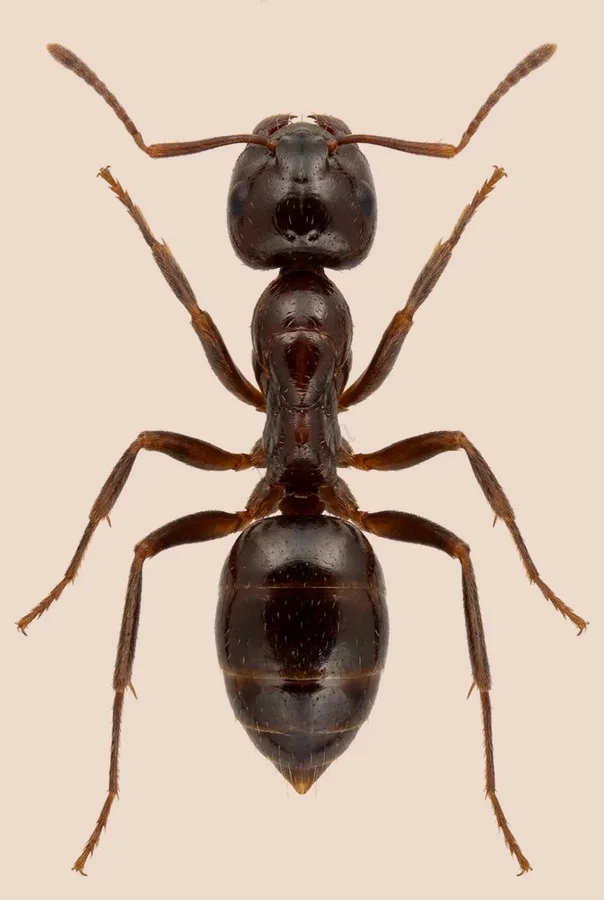
American winter ant
This ant forages mainly in cold weather, active even when temperatures barely top freezing, then seals itself underground through the hottest weeks of summer.
| Where | Wooded areas with sandy or clay soil |
|---|---|
| Size | 2.5 to 3.5 mm body length |
| When | September to December and February to June |
The American winter ant is small and hourglass-shaped, with workers about 2.5 to 3.5 mm long in shades of light to dark brown; queens are larger and reddish-brown, while males are black. Well-fed workers can swell into shiny, rounded 'repletes' that store liquid food for the colony.
Colonies dig deep nests in wooded soil, with short dead-end tunnels near shady tree bases, and workers forage above ground mostly during winter and early spring. Rather than stinging or biting, a threatened worker releases a mild secretion from glands near the tip of its abdomen, and the whole colony retreats underground to sit out the hottest part of summer.
Traits
Habitat
Woodland
Colour
Brown
Active
Day
To people
Safe to handle; it does not sting or bite people.
Activity through the year
Often confused with
A similar small brown ant often found near buildings, but it gives off a strong rotten-coconut smell when crushed, unlike the winter ant's mild, nearly odorless secretion.
Questions
Is the American winter ant dangerous to people?
Safe to handle; it does not sting or bite people.
When can you see the American winter ant?
The American winter ant can be seen from September to December and February to June, by day.
Plate retouched from a photo by Corey Farwell, CC BY 4.0, iNaturalist Licence
Report a mistake in this entry
Bees, wasps and ants›Ants›Prenolepis
Last updated 2026-09-27. Every entry is checked against published sources.