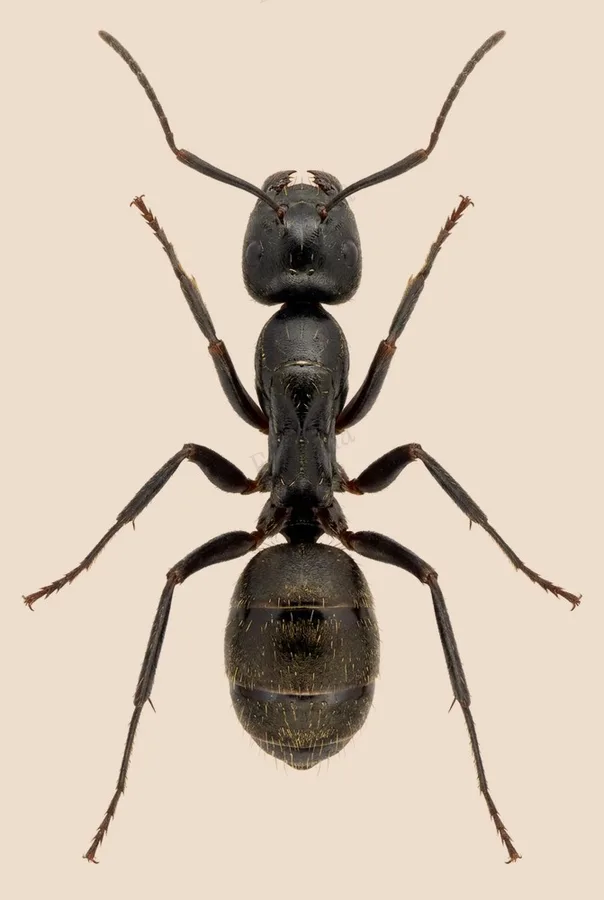
Eastern black carpenter ant
Workers defend the nest with a painful bite and can spray formic acid into the wound afterward, though the species has no sting at all.
| Where | Forests, dead wood and buildings |
|---|---|
| Size | 6 to 17 mm body length |
| When | March to October |
Workers are dull black with a dense fringe of pale yellowish hairs on the abdomen. Colonies include several worker sizes, from about 6 mm minor workers up to large soldiers reaching roughly 17 mm.
Colonies nest in moist or decaying wood, including tree cavities, stumps and water damaged parts of buildings, tunneling out smooth galleries to raise brood without eating the wood itself. Workers forage mainly after dark, and a mature colony can hold several thousand ants headed by one queen.
Traits
Habitat
Woodland
Colour
Black
Active
Night
To people
Mild
Bites defensively with strong jaws and can spray formic acid into the wound for a brief burning sting, though the species cannot sting and bites rarely cause lasting harm.
Activity through the year
Often confused with
A similarly large carpenter ant, but with a reddish brown head and thorax contrasting against a black abdomen, rather than the uniformly black body of the eastern black carpenter ant.
Questions
Is the Eastern black carpenter ant dangerous to people?
Mild. Bites defensively with strong jaws and can spray formic acid into the wound for a brief burning sting, though the species cannot sting and bites rarely cause lasting harm.
When can you see the Eastern black carpenter ant?
The Eastern black carpenter ant can be seen from March to October, at night.
Plate retouched from a photo by Healthy Yards, CC BY 4.0, iNaturalist Licence
Report a mistake in this entry
Bees, wasps and ants›Ants›Camponotus
Last updated 2026-09-26. Every entry is checked against published sources.