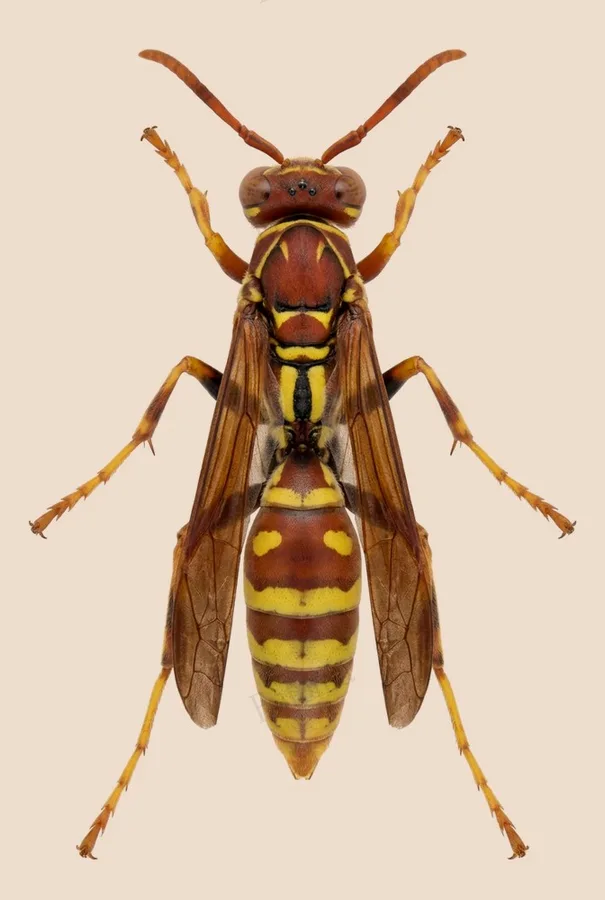
Guinea paper wasp
Its species name comes from the sudden exclamation people make after bumping a nest, since this wasp stings hard once disturbed.
| Where | Building eaves and garden structures |
|---|---|
| Size | 19 to 25 mm body length |
| When | March to November |
The Guinea paper wasp is a slender, narrow-waisted wasp with a reddish-brown body, yellow markings and smoky wings folded lengthwise at rest. Its antennae are banded with red, black and yellow, a pattern that separates it from paper wasps with a single antenna colour.
Colonies build open, uncapped paper nests hung by a single stalk under eaves, on fences and among shrubs, growing from a few founding queens in spring to dozens of workers by late summer. The wasps tolerate disturbance nearby but sting repeatedly and readily once their nest is jarred.
Traits
Habitat
Towns
Colour
Brown, Yellow, Black
Active
Day
To people
Take care
Not aggressive away from the nest but stings repeatedly in its defence; use caution near nests.
Activity through the year
Often confused with
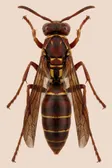
Similar in build and colour, but has plain, single-coloured antennae rather than the red, black and yellow banded antennae of the Guinea paper wasp.
Questions
Is the Guinea paper wasp dangerous to people?
Take care. Not aggressive away from the nest but stings repeatedly in its defence; use caution near nests.
When can you see the Guinea paper wasp?
The Guinea paper wasp can be seen from March to November, by day.
Plate retouched from a photo by Catherine C. Galley, CC BY 4.0, iNaturalist Licence
Report a mistake in this entry
Bees, wasps and ants›Potter wasps›Polistes
Last updated 2026-09-26. Every entry is checked against published sources.