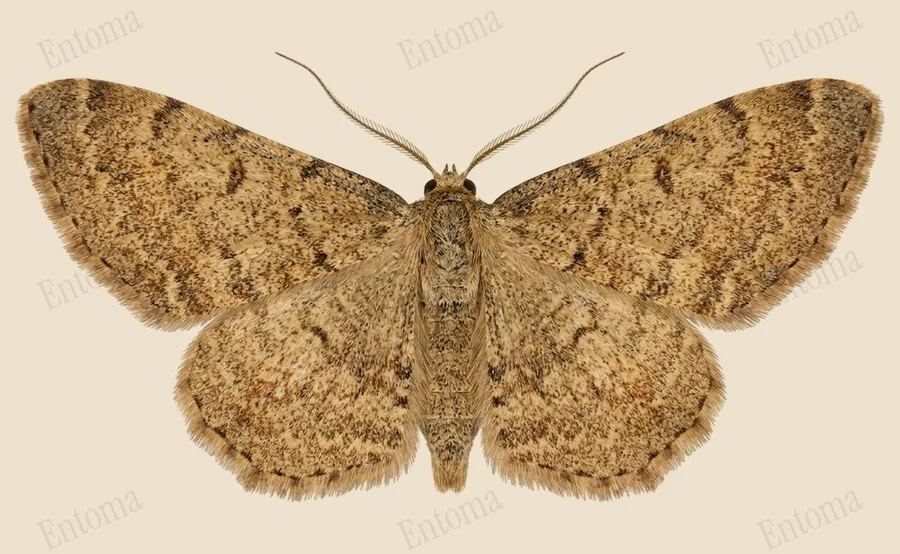
Common tan wave
This small geometer moth often turns up around cornfields because its caterpillars readily eat corn silk, though they can just as easily switch to goldenrod or oak leaves.
| Where | Field edges, farmland and woodlands |
|---|---|
| Size | 14 to 21 mm wingspan |
| When | May to October |
The Common tan wave is a small, pale yellowish-brown moth with a faint greenish cast, crossed by thin wavy dark lines and tiny reddish-brown dots along a scalloped, pale submarginal line.
It produces several generations a year across the warmer parts of its range, and its caterpillars feed mainly on corn silk but will also eat bedstraw, goldenrod, oak and willow leaves.
Traits
Habitat
Farmland
Colour
Yellow, Brown, Green
Active
Night
To people
Harmless to people; it comes readily to lights at night.
Activity through the year
Often confused with
Packard's wave has more uniformly yellowish to orangish-brown wings, without the Common tan wave's thin dark wavy lines and small reddish-brown dots along the margin.
Questions
Is the Common tan wave dangerous to people?
Harmless to people; it comes readily to lights at night.
When can you see the Common tan wave?
The Common tan wave can be seen from May to October, at night.
Plate retouched from a photo by Annika Lindqvist, CC BY 4.0, iNaturalist Licence
Report a mistake in this entry
Butterflies and moths›Geometer moths›Pleuroprucha
Last updated 2026-09-27. Every entry is checked against published sources.