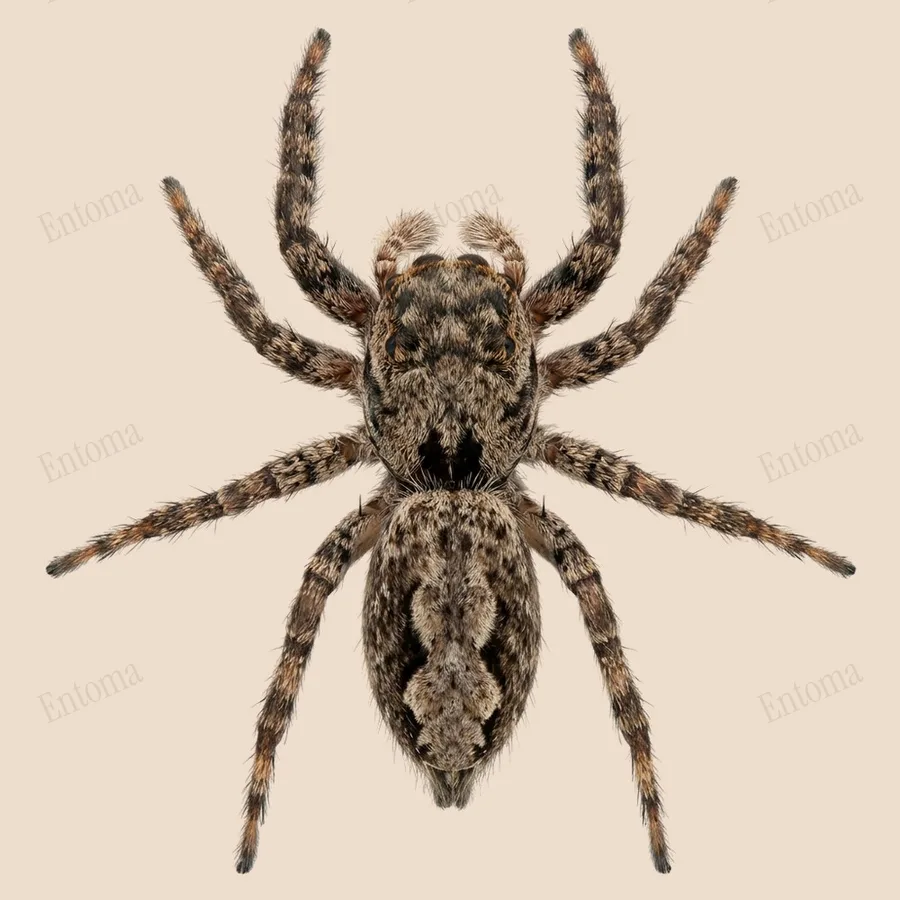
Tan jumping spider
Its flattened, mottled brown body lets this spider all but disappear against tree bark or wooden siding while it waits and watches for passing insects.
| Where | Tree trunks, fences and building walls |
|---|---|
| Size | Female 10 to 13 mm, male 8.5 to 9.5 mm body length |
| When | March to October |
The Tan jumping spider has a thin, flattened brown body patterned with pale chevron markings down the abdomen, an adaptation for hiding in narrow gaps under bark or siding. Females carry a white band of hairs below their large front eyes, while mature males show the same band in orange.
It hunts by day on tree trunks, fence posts and building walls, relying on sharp eyesight to stalk and pounce on small insects rather than building a snare. At night it retreats into a silk-lined pocket in bark or a crevice, and recent studies note some individuals staying active near porch lights after dark.
Traits
Habitat
Towns
Colour
Brown
Active
Day
To people
This spider rarely bites and does so only when squeezed or pinned, causing no more than brief, mild discomfort; it is not dangerous to people.
Activity through the year
Often confused with
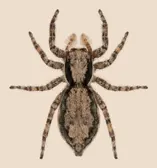
An overall gray rather than tan body color, with the color pattern reversed between males and females compared with the Tan jumping spider, though both share a flattened shape on bark and walls.
Questions
Is the Tan jumping spider dangerous to people?
This spider rarely bites and does so only when squeezed or pinned, causing no more than brief, mild discomfort; it is not dangerous to people.
When can you see the Tan jumping spider?
The Tan jumping spider can be seen from March to October, by day.
Plate retouched from a photo by Juan C. Espinosa, CC BY 4.0, iNaturalist Licence
Report a mistake in this entry
Spiders›Jumping spiders›Platycryptus
Last updated 2026-09-27. Every entry is checked against published sources.