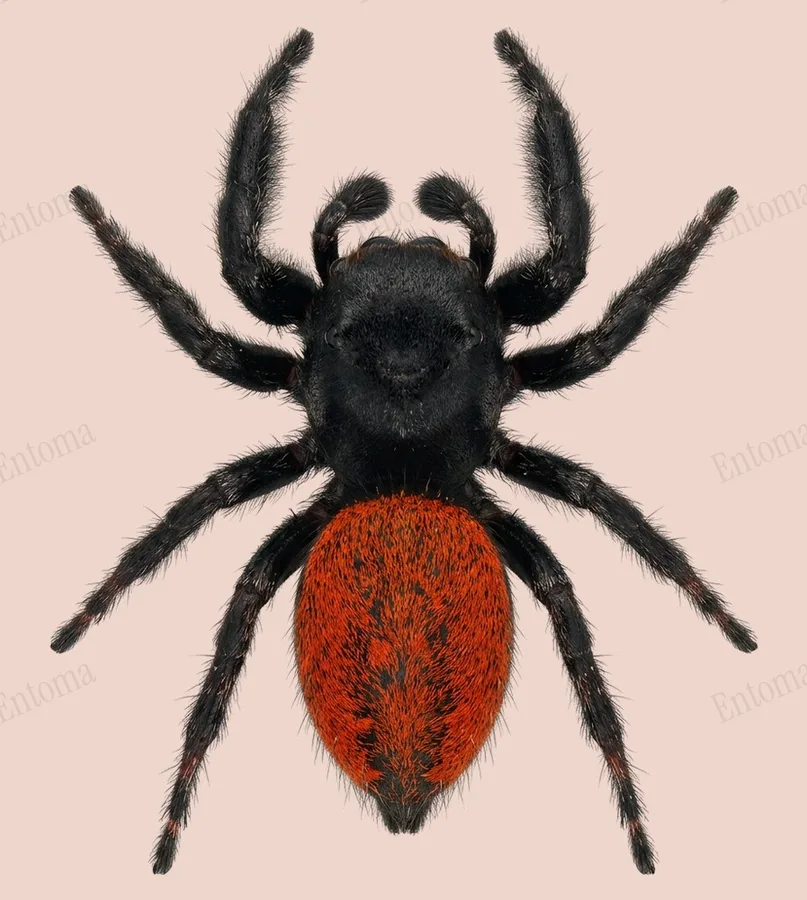
Johnson's jumping spider
This bold jumping spider tackles prey many times its own size, relying on sharp color vision and a sudden pounce rather than any web.
| Where | Open habitats across western North America |
|---|---|
| Size | Female 9 to 14 mm, male 6 to 11 mm body length |
| When | February to November |
Johnson's jumping spider has a black body with iridescent green chelicerae and a bright red abdomen, marked in females with a black central stripe that males lack. It is one of the largest and most often seen jumping spiders in the region.
It hunts by day across open ground and low vegetation, using keen eyesight to stalk flies, moths and other spiders. It is common through western North America from the Rocky Mountains to the Pacific coast, extending north into Canada.
Traits
Habitat
Garden
Colour
Black, Red, Green
Active
Day
To people
Mild
Can deliver a painful bite if handled roughly, with local swelling and itching that fades within a few days, but it poses no serious medical risk; most of the injury comes from the fangs themselves rather than the venom.
Activity through the year
Often confused with
Both sexes look alike, with a black median stripe and a pair of small white spots near the rear of the abdomen, unlike Johnson's jumping spider, where only females carry the black stripe and males are solid red.
Questions
Is the Johnson's jumping spider dangerous to people?
Mild. Can deliver a painful bite if handled roughly, with local swelling and itching that fades within a few days, but it poses no serious medical risk; most of the injury comes from the fangs themselves rather than the venom.
When can you see the Johnson's jumping spider?
The Johnson's jumping spider can be seen from February to November, by day.
Plate retouched from a photo by P Holroyd, CC BY 4.0, iNaturalist Licence
Report a mistake in this entry
Spiders›Jumping spiders›Phidippus
Last updated 2026-09-27. Every entry is checked against published sources.