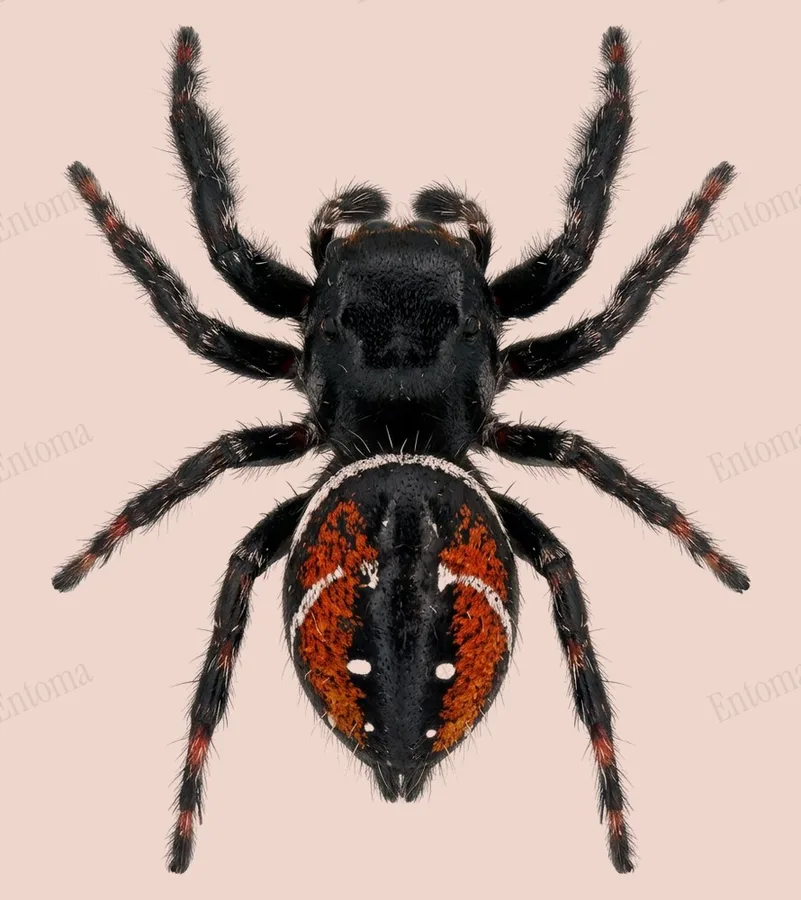
Brilliant jumping spider
Male brilliant jumping spiders have a bright red abdomen crossed by a black stripe, and a bite, though rare, is no worse than a brief bee sting.
| Where | Old fields and weedy open habitats |
|---|---|
| Size | Female 8 to 14 mm, male 3 to 6 mm body length |
| When | May to September |
The brilliant jumping spider is a large, hairy jumper. Males are mostly black with a bright red abdomen crossed by a black stripe and white-banded palps, while females are duller, in shades of gray, tan, brown or orange, sometimes matching the darker male pattern.
It hunts by sight rather than by web, creeping close to prey on the upper parts of plants before pouncing, trailing a silk safety line as it jumps. Found in old fields and weedy, open habitats across most of North America, adults are most active from May to September, often sharing flowering plants with crab spiders that hunt the same insects.
Traits
Habitat
Grassland
Colour
Black, Red, White
Active
Day
To people
This jumping spider can bite if trapped against the skin, but it is quick to flee, and any bite is no more painful than a bee sting, not dangerous to people.
Activity through the year
Often confused with
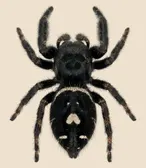
Adults are black with paired white spots on the abdomen and a fuzzy overall appearance, never the solid red abdomen crossed by a black stripe seen on male brilliant jumping spiders.
Questions
Is the Brilliant jumping spider dangerous to people?
This jumping spider can bite if trapped against the skin, but it is quick to flee, and any bite is no more painful than a bee sting, not dangerous to people.
When can you see the Brilliant jumping spider?
The Brilliant jumping spider can be seen from May to September, by day.
Plate retouched from a photo by Shinobu, CC BY 4.0, iNaturalist Licence
Report a mistake in this entry
Spiders›Jumping spiders›Phidippus
Last updated 2026-09-27. Every entry is checked against published sources.