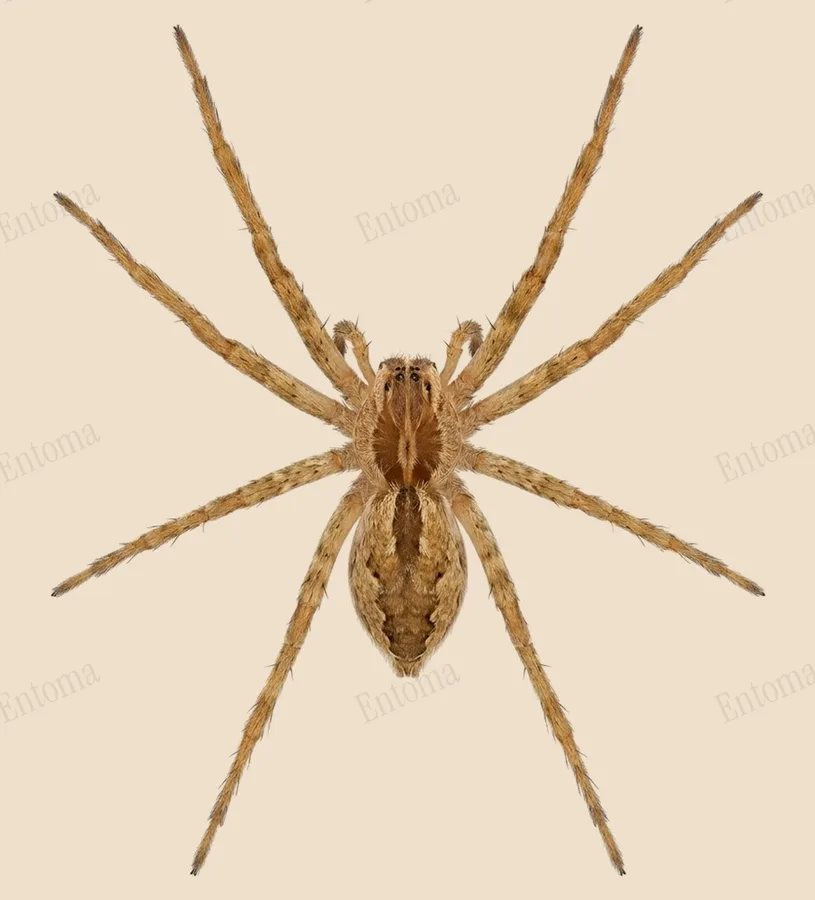
American nursery web spider
A female of this spider carries her egg sac in her fangs, then spins a silk tent nursery in nearby leaves and guards the spiderlings inside.
| Where | Forest edges, fields and tall grass |
|---|---|
| Size | Female 12 to 17 mm, male 10 to 15 mm body length |
| When | March to October |
This spider is yellowish brown to beige with a broad dark stripe running the length of the body and a narrow white border around the abdomen, though some individuals lack the stripe. It is often mistaken for a wolf spider, but it holds two evenly sized rows of eyes rather than the wolf spider's enlarged forward facing pair.
It waits motionless on foliage or actively hunts insects both by day and after dark, often gathering at outdoor lights. Mating happens in midsummer, after which the female builds a tangled nursery web on foliage to guard her egg sac and newly hatched young.
Traits
Habitat
Grassland
Colour
Brown, Yellow, White
Active
Day and night
To people
This spider does not bite people; it is not dangerous and simply hunts insects on foliage and around outdoor lights.
Activity through the year
Often confused with
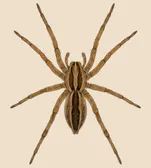
Often confused with wolf spiders, but this species has two even rows of similarly sized eyes, while the rabid wolf spider and other wolf spiders have a pair of very large, forward facing eyes in the middle row.
Questions
Is the American nursery web spider dangerous to people?
This spider does not bite people; it is not dangerous and simply hunts insects on foliage and around outdoor lights.
When can you see the American nursery web spider?
The American nursery web spider can be seen from March to October, by day and at night.
Plate retouched from a photo by Nick Block, CC BY 4.0, iNaturalist Licence
Report a mistake in this entry
Spiders›Nursery web spiders›Pisaurina
Last updated 2026-09-27. Every entry is checked against published sources.