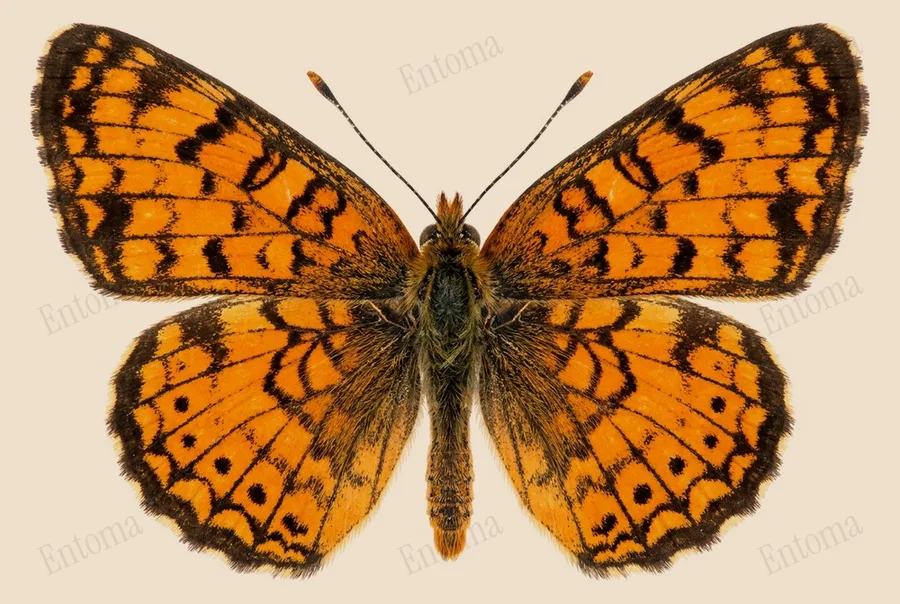
Mylitta crescent
Its caterpillars feed almost exclusively on prickly thistles, letting this small orange butterfly turn a noxious weed into next season's wings.
| Where | Weedy fields, roadsides and streamsides |
|---|---|
| Size | 29 to 38 mm wingspan |
| When | March to October |
The Mylitta crescent is a small orange butterfly marked above with black spots, checks and a black border, with a row of small black dots ringed in orange along the hindwing edge. Males carry a plain, unmarked orange patch on the hindwing that females lack, and the underside shows cream, tan and brown bands ending in a bright crescent mark near the margin.
Caterpillars feed on thistles, including Canada thistle, and the species overwinters as a partly grown larva before finishing development the following spring. Several generations fly each year across a range that runs from weedy fields and roadsides to streamsides in the mountains of western North America.
Traits
Habitat
Grassland
Colour
Orange, Black, White
Active
Day
To people
Harmless to people, and rarely far from the thistles its caterpillars depend on.
Activity through the year
Often confused with
Overlapping in wingspan at about 25 to 38 mm, but the Field crescent looks darker and duskier above, with blackish-brown ground color, while the Mylitta crescent is brighter orange with sharp black spots and checks.
Questions
Is the Mylitta crescent dangerous to people?
Harmless to people, and rarely far from the thistles its caterpillars depend on.
When can you see the Mylitta crescent?
The Mylitta crescent can be seen from March to October, by day.
Plate retouched from a museum specimen photo by Stephen Nachtsheim, Colorado State University, C.P. Gillette Museum of Arthropod Diversity, CC0, GBIF Licence
Report a mistake in this entry
Butterflies and moths›Brush-footed butterflies›Phyciodes
Last updated 2026-09-27. Every entry is checked against published sources.