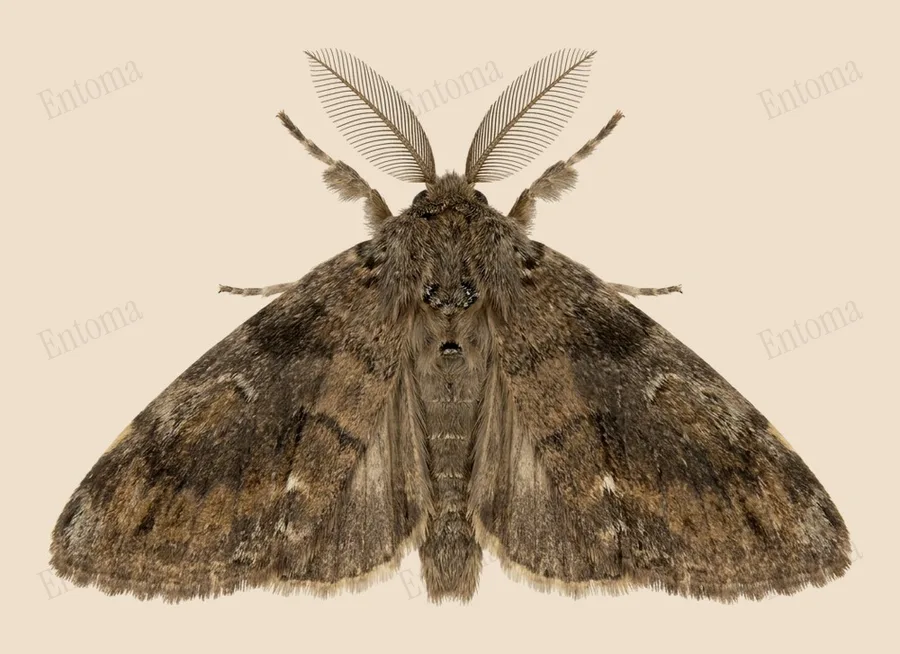
White-marked tussock moth
Females are wingless and never fly, laying their entire egg mass on the outside of the cocoon where they themselves developed.
| Where | Shade trees, orchards and city landscapes |
|---|---|
| Size | 25 to 35 mm wingspan (males only) |
| When | April to October |
The White-marked tussock moth caterpillar has a bright red head, four tight cream colored hair tufts on its back, and a longer pair of dark hair pencils near the head and tail. Adult males are small grayish brown moths, while females are wingless and stay on their cocoon.
Caterpillars feed on more than a hundred kinds of shade trees, orchard trees, and shrubs across cities, orchards, and forests. Their hairs are barbed and can puncture skin, causing itching and a rash in sensitive people who handle them.
Traits
Habitat
Towns
Colour
Red, Yellow, Black
Active
Night
To people
Mild
Caterpillar hairs can irritate skin, so it is best not to handle them with bare hands.
Activity through the year
Often confused with
Caterpillar has a tan or yellow head rather than the bright red head of the White-marked tussock moth, the clearest way to separate the two larvae.
Questions
Is the White-marked tussock moth dangerous to people?
Mild. Caterpillar hairs can irritate skin, so it is best not to handle them with bare hands.
When can you see the White-marked tussock moth?
The White-marked tussock moth can be seen from April to October, at night.
Plate retouched from a photo by Stan Rullman, CC BY 4.0, iNaturalist Licence
Report a mistake in this entry
Butterflies and moths›Erebid moths›Orgyia
Last updated 2026-09-26. Every entry is checked against published sources.