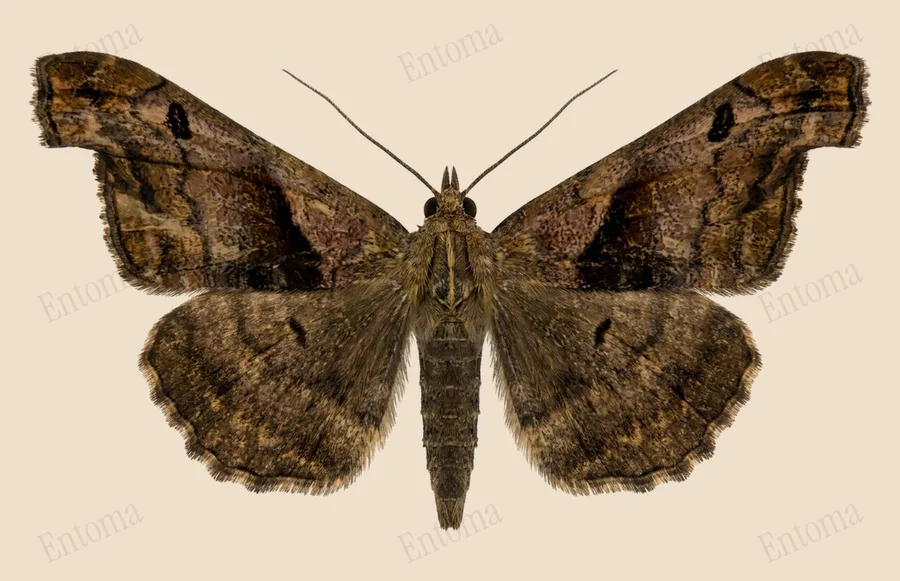
Dark-spotted palthis moth
Males carry upturned palps that jut above the head like a small beak, a feature used to separate this species from its close look-alike.
| Where | Woodlands, thickets and shrubby edges |
|---|---|
| Size | 20 to 26 mm wingspan |
| When | April to September |
This moth has light brown to tan wings marked with dark brown lines and a single solid dark spot at the centre of each forewing. At rest its wings form a flat, jet-plane-like shape.
Caterpillars feed on a wide range of trees and shrubs, including alder, birch and oak. Two generations fly across most of its range, with three or more further south.
Traits
Habitat
Woodland
Colour
Brown
Active
Night
To people
Comes to lights at night and is harmless to handle.
Activity through the year
Often confused with
The dark spot at the centre of its forewing is broken by a thin white line, while the Dark-spotted Palthis moth has one solid, unbroken spot.
Questions
Is the Dark-spotted palthis moth dangerous to people?
Comes to lights at night and is harmless to handle.
When can you see the Dark-spotted palthis moth?
The Dark-spotted palthis moth can be seen from April to September, at night.
Plate retouched from a photo by Jason Hill, CC BY 4.0, iNaturalist Licence
Report a mistake in this entry
Butterflies and moths›Erebid moths›Palthis
Last updated 2026-09-27. Every entry is checked against published sources.