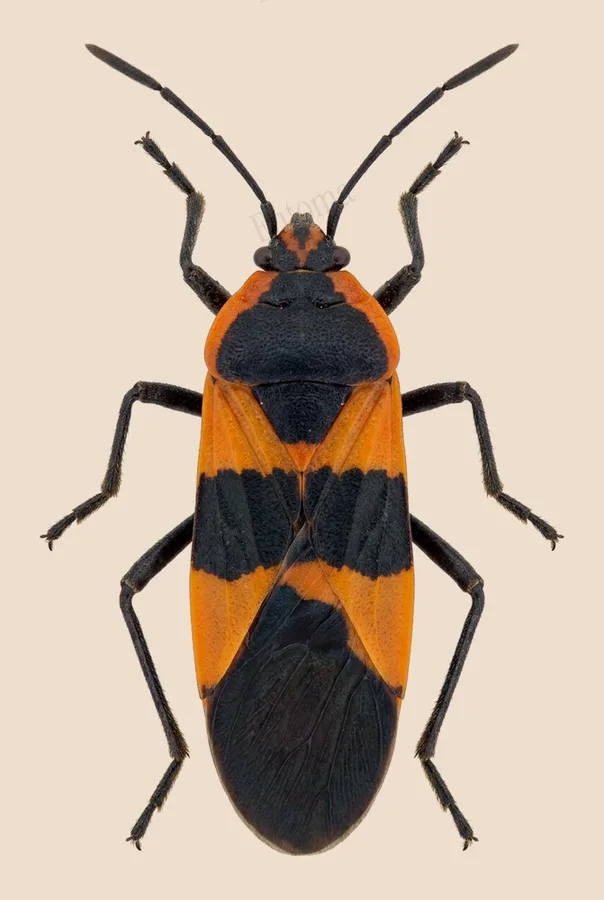
Large milkweed bug
It feeds mainly on milkweed seeds through a needle-like mouthpart and stores the plant's bitter defensive chemicals in its own body.
| Where | Milkweed patches in open fields |
|---|---|
| Size | 10 to 18 mm body length |
| When | April to November |
The Large milkweed bug has a black head and an orange body marked with a wide black band across the wings, forming a pattern of orange triangles pointing toward and away from the body on each side.
Nymphs and adults gather in groups on milkweed seed pods, drawing out fluid from the developing seeds, and populations move north from warmer regions each year rather than surviving cold winters in place.
Traits
Habitat
Grassland
Colour
Orange, Black
Active
Day
To people
Mild
Not for eating; sequesters bitter, toxic compounds from milkweed that make it distasteful to predators, though it cannot sting or bite.
Activity through the year
Often confused with
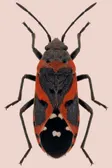
Both are orange and black milkweed feeders, but the Small milkweed bug is smaller with a black heart shape inside an orange X on each forewing, while the Large milkweed bug shows solid orange triangles separated by a wide black band.
Questions
Is the Large milkweed bug dangerous to people?
Mild. Not for eating; sequesters bitter, toxic compounds from milkweed that make it distasteful to predators, though it cannot sting or bite.
When can you see the Large milkweed bug?
The Large milkweed bug can be seen from April to November, by day.
Plate retouched from a photo by kenkneidel, CC0, iNaturalist Licence
Report a mistake in this entry
True bugs›Seed bugs›Oncopeltus
Last updated 2026-09-26. Every entry is checked against published sources.