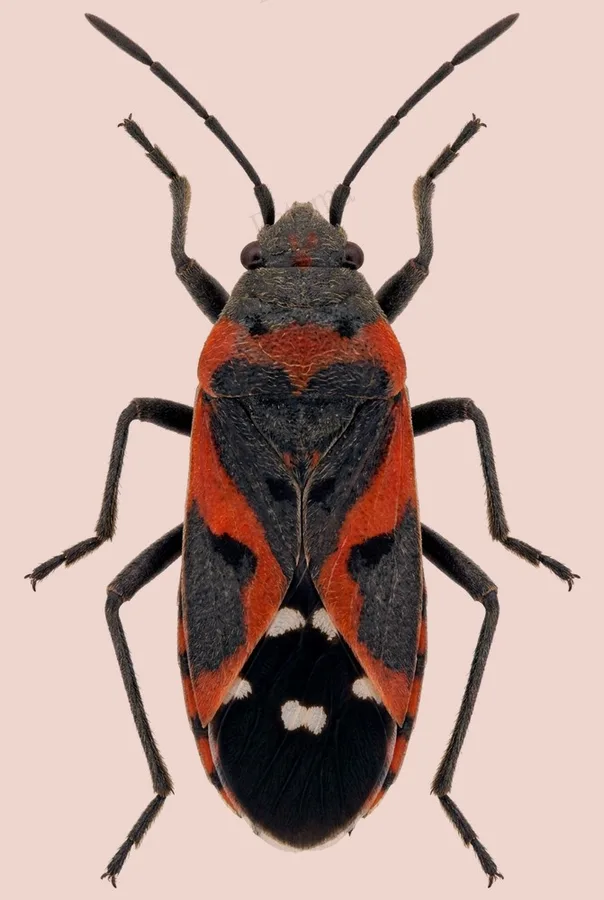
Small milkweed bug
Adults store heart toxins from milkweed in their bodies, so a bird that eats one usually vomits and then avoids its red and black pattern.
| Where | Fields and meadows with milkweed |
|---|---|
| Size | 10 to 13 mm body length |
| When | March to October |
The small milkweed bug is a slender, orange red and black bug about 10 to 13 mm long, with a black X or hourglass shape across the closed wings, a red band on the pronotum, and small white spots near the wingtips.
Adults and nymphs feed mainly on milkweed seeds and sap, sequestering the plant's cardiac glycosides in their bodies as a defense, and will also eat dead or trapped insects, including monarch caterpillars, found on milkweed plants.
Traits
Habitat
Grassland
Colour
Red, Black, White
Active
Day
To people
Mild
Not known to bite or sting, but its bright colors warn that it stores mild plant toxins that make it distasteful and mildly poisonous if eaten.
Activity through the year
Often confused with
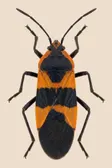
A larger milkweed bug with a plain black band across the middle of the back and orange margins, rather than the small milkweed bug's black X shaped mark on a red background.
Questions
Is the Small milkweed bug dangerous to people?
Mild. Not known to bite or sting, but its bright colors warn that it stores mild plant toxins that make it distasteful and mildly poisonous if eaten.
When can you see the Small milkweed bug?
The Small milkweed bug can be seen from March to October, by day.
Plate retouched from a photo by sealgyu, CC0, iNaturalist Licence
Report a mistake in this entry
Last updated 2026-09-26. Every entry is checked against published sources.