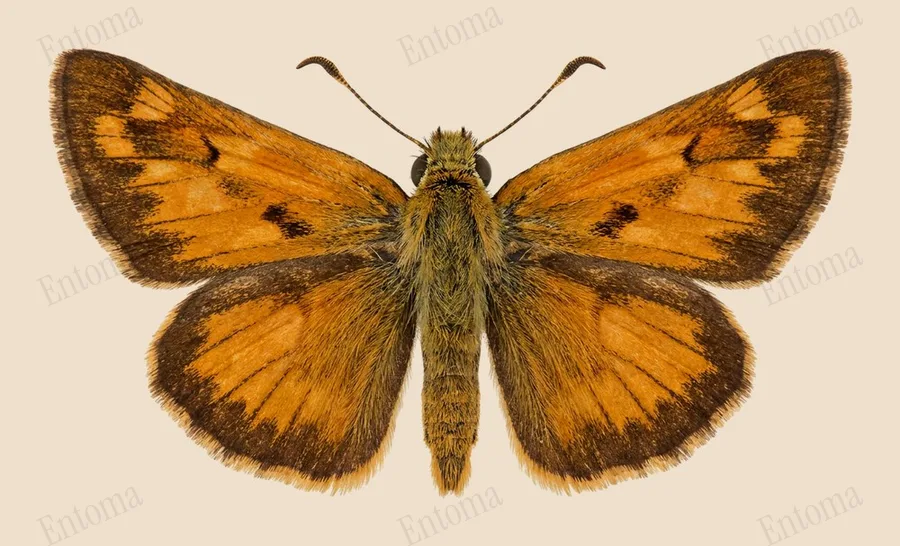
Woodland skipper
Woodland Skippers rest with their forewings held upright in a V and hindwings spread flat, a jet-plane pose shared by grass skippers generally.
| Where | Open grassy and brushy habitats |
|---|---|
| Size | 25 to 32 mm wingspan |
| When | July to September |
This small, orange skipper has toothed dark brown borders on the upperside and a variable underside ranging from yellow to reddish brown. Males show a narrow black stigma on the forewing, while females have a plain dark patch in its place.
Caterpillars feed on grasses including Bermuda grass and wheatgrass, and a single generation flies through late summer into fall across the species' range. In many areas it becomes one of the most commonly seen butterflies of September and October.
Traits
Habitat
Grassland
Colour
Orange, Brown
Active
Day
To people
Harmless to people; it can become one of the most common butterflies seen in early fall.
Activity through the year
Often confused with
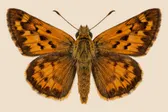
Distinctly larger, with a wingspan of about 35 to 41 mm against the Woodland Skipper's 25 to 32 mm, and less toothed wing borders.
Questions
Is the Woodland skipper dangerous to people?
Harmless to people; it can become one of the most common butterflies seen in early fall.
When can you see the Woodland skipper?
The Woodland skipper can be seen from July to September, by day.
Plate retouched from a museum specimen photo by Stephen Nachtsheim, Colorado State University, C.P. Gillette Museum of Arthropod Diversity, CC0, GBIF Licence
Report a mistake in this entry
Butterflies and moths›Skippers›Ochlodes
Last updated 2026-09-26. Every entry is checked against published sources.