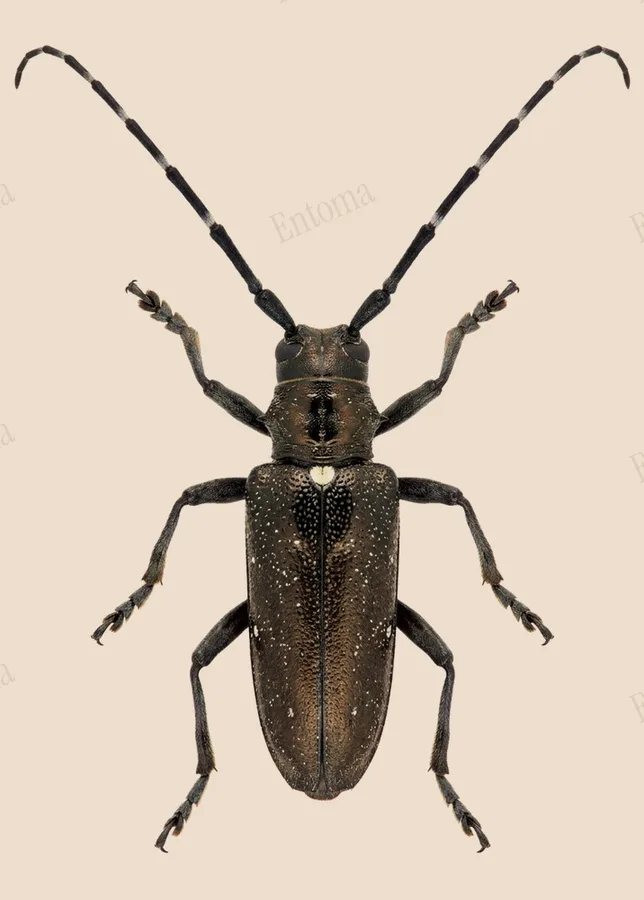
White-spotted sawyer
Despite jaws strong enough to gnaw through solid wood, this beetle cannot hurt a person, and males carry antennae up to three times their own body length.
| Where | Coniferous forests with dying trees |
|---|---|
| Size | 18 to 32 mm body length |
| When | May to September |
Adults are black long-horned beetles with a single white spot where the wing covers meet and, in some individuals, extra pale speckling across the elytra. A short spine projects from each side of the thorax, and males carry antennae up to three times their own body length.
Adults emerge in summer and feed briefly on the bark and shoots of living conifer twigs before mating, while larvae tunnel through the wood of dead or dying pine, spruce and fir, making the species mainly a secondary pest of already weakened trees.
Traits
Habitat
Woodland
Colour
Black, White
Active
Day
To people
Has strong jaws for boring into wood but cannot hurt a person if handled; considered only a minor pest of already weakened conifers.
Activity through the year
Often confused with
The northeastern pine sawyer is larger, with a dull gray body close to two inches long, while the white-spotted sawyer is black and only about one to one and a quarter inch long.
Questions
Is the White-spotted sawyer dangerous to people?
Has strong jaws for boring into wood but cannot hurt a person if handled; considered only a minor pest of already weakened conifers.
When can you see the White-spotted sawyer?
The White-spotted sawyer can be seen from May to September, by day.
Plate retouched from a photo by Dustin VanOverbeke, CC BY 4.0, iNaturalist Licence
Report a mistake in this entry
Beetles›Longhorn beetles›Monochamus
Last updated 2026-09-26. Every entry is checked against published sources.