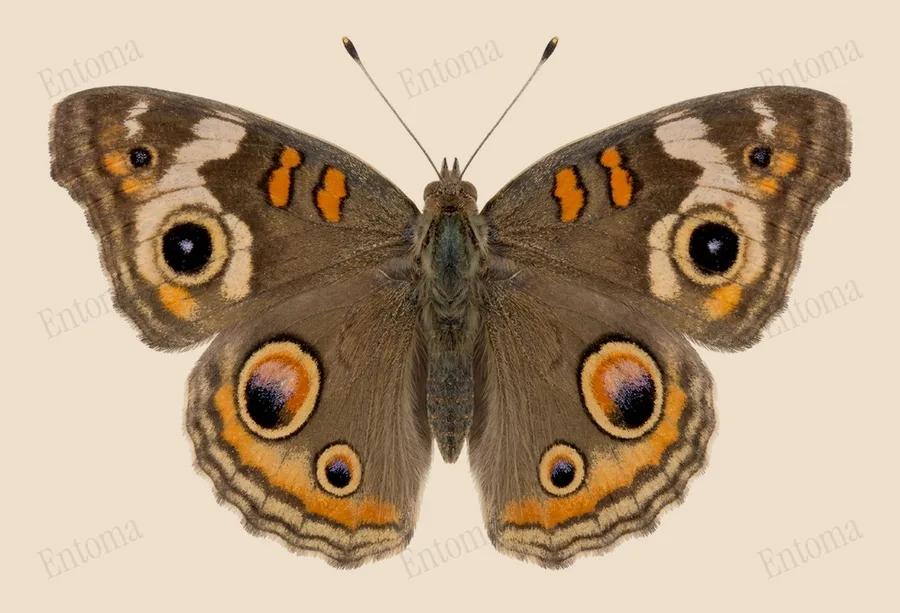
Gray buckeye
Genetic studies only separated the Gray buckeye from the nearly identical Common buckeye in 2018, though the two still look almost exactly alike.
| Where | Dry hills, washes and forest openings |
|---|---|
| Size | 41 to 70 mm wingspan |
| When | March to November |
The Gray buckeye is a mauve brown butterfly with large eyespots on both fore and hindwings, plus a curved ivory band and two orange bars near the leading edge of the forewing. The pattern is nearly identical to the Common buckeye found across most of North America.
Caterpillars feed on low plants in the plantain and snapdragon families, including toadflax and ruellia, and adults bask with wings open on bare ground. Two to three broods fly in a year, and adults can survive mild winters to breed again in spring.
Traits
Habitat
Heath
Colour
Brown, Orange
Active
Day
To people
Visits garden and roadside flowers for nectar; does not sting or bite people.
Activity through the year
Often confused with
Nearly identical in pattern; the two are best told apart by range, since the Common buckeye occurs across most of North America while the Gray buckeye stays west of the Rocky Mountains.
Questions
Is the Gray buckeye dangerous to people?
Visits garden and roadside flowers for nectar; does not sting or bite people.
When can you see the Gray buckeye?
The Gray buckeye can be seen from March to November, by day.
Plate retouched from a photo by Franco Folini, CC BY 4.0, iNaturalist Licence
Report a mistake in this entry
Butterflies and moths›Brush-footed butterflies›Junonia
Last updated 2026-09-26. Every entry is checked against published sources.