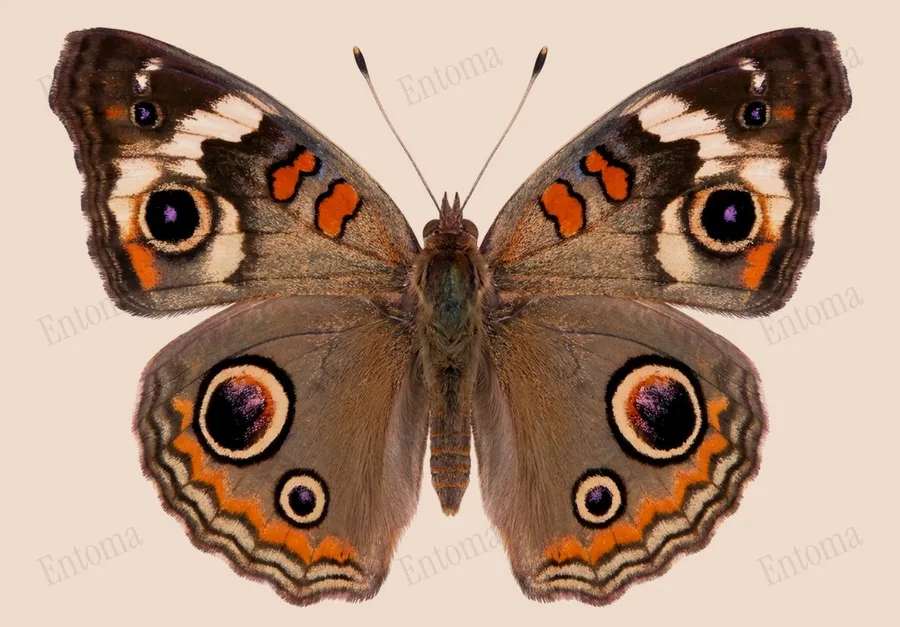
Common buckeye
Large eyespots on its wings can startle a hunting bird for just long enough to let this butterfly escape.
| Where | Open fields, dunes, and roadsides |
|---|---|
| Size | 38 to 70 mm wingspan |
| When | March to November |
The Common buckeye has gray-brown wings marked with two large, dark eyespots ringed in orange and blue on each hindwing, plus a smaller pair near the forewing tip, and a pale cream band crossing the forewing.
Caterpillars feed on plants of the plantain and snapdragon families, taking up bitter iridoid compounds from these hosts that make them distasteful to ants, and northern populations cannot survive winter, so the species recolonizes the north each year as adults move up from the south.
Traits
Habitat
Grassland
Colour
Brown, Orange, Black
Active
Day
To people
Does not sting or bite; basks with wings open on bare soil or paths.
Activity through the year
Often confused with
Similar wing shape and eyespot pattern, but the Mangrove buckeye has reddish-brown wings with a warm orange-cream forewing band, while the Common buckeye is gray-brown with a paler, more yellowish-cream band.
Questions
Is the Common buckeye dangerous to people?
Does not sting or bite; basks with wings open on bare soil or paths.
When can you see the Common buckeye?
The Common buckeye can be seen from March to November, by day.
Plate retouched from a photo by Lauren McLaurin, CC BY 4.0, iNaturalist Licence
Report a mistake in this entry
Butterflies and moths›Brush-footed butterflies›Junonia
Last updated 2026-09-26. Every entry is checked against published sources.