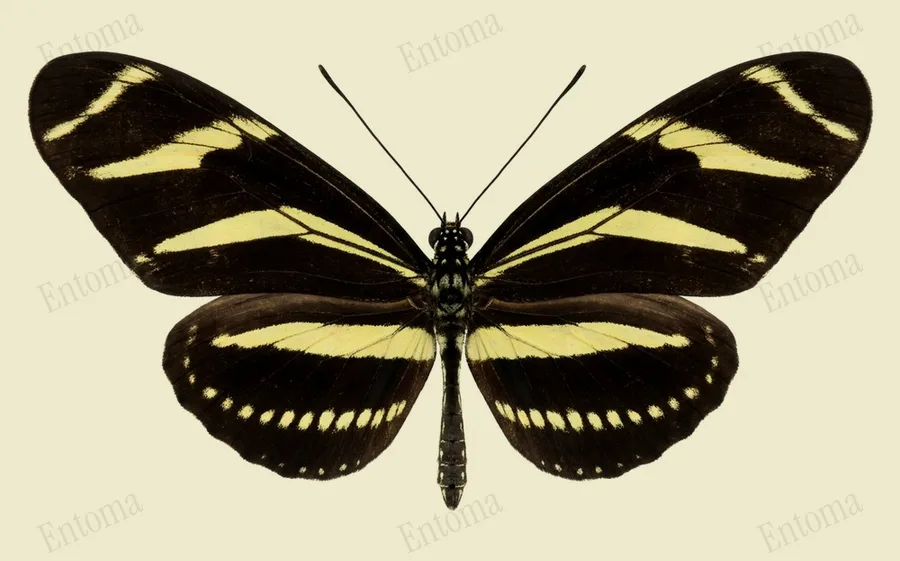
Zebra longwing
Adults live for months rather than weeks because they eat pollen as well as nectar, an unusual habit that also helps make their bodies toxic to predators.
| Where | Forest edges, thickets and gardens |
|---|---|
| Size | 72 to 100 mm wingspan |
| When | January to December |
The Zebra longwing has long, narrow black wings crossed by bold yellow and white stripes, with small red spots on the paler underside. Its elongated wing shape sets it apart from most other North American butterflies.
Caterpillars feed only on passionflower vines, from which they draw chemicals that make both caterpillar and adult unpalatable to predators. Adults roost together in groups of up to sixty each night, often returning to the same branch.
Traits
Habitat
Garden
Colour
Black, Yellow, White
Active
Day
To people
Mild
Safe to handle; its toxicity is a defence against birds and lizards that try to eat it, not a threat to people.
Activity through the year
Often confused with
Almost entirely orange above with no black and yellow banding, quite unlike the Zebra longwing's bold black wings crossed by narrow yellow and white stripes.
Questions
Is the Zebra longwing dangerous to people?
Mild. Safe to handle; its toxicity is a defence against birds and lizards that try to eat it, not a threat to people.
When can you see the Zebra longwing?
The Zebra longwing can be seen from January to December, by day.
Plate retouched from a photo by Rodolfo Salinas Villarreal, CC BY 4.0, iNaturalist Licence
Report a mistake in this entry
Butterflies and moths›Brush-footed butterflies›Heliconius
Last updated 2026-09-27. Every entry is checked against published sources.