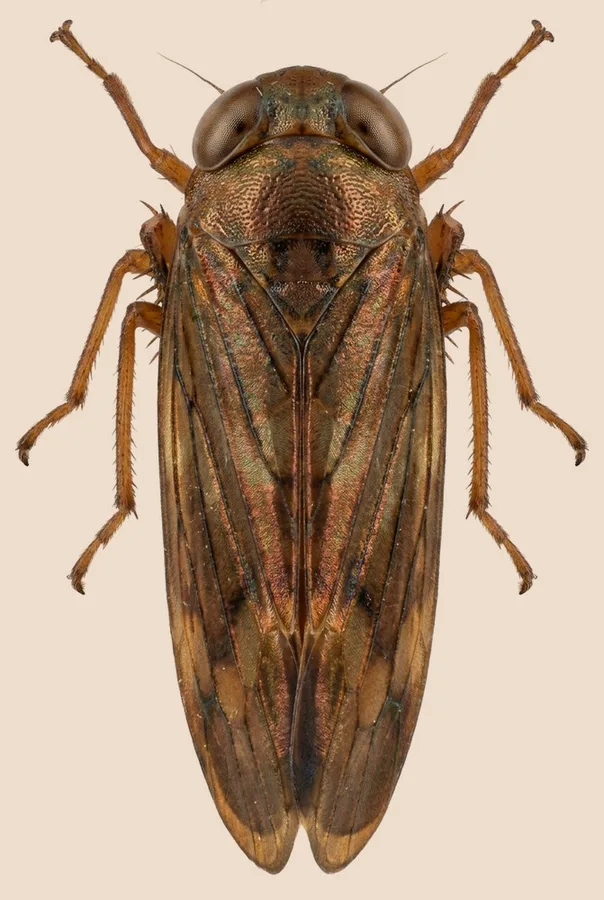
Coppery leafhopper
Despite its name, this leafhopper is not always coppery: individuals can appear green, blue or brown, so color alone cannot confirm its identity.
| Where | Vineyard edges, scrub and woodland |
|---|---|
| Size | 6 to 8 mm body length |
| When | May to October |
The Coppery leafhopper is a small, wedge-shaped insect about 6 to 8 mm long, with a broad, rounded head wider than the front of the thorax and wings that slope down the back like a tent. Coloring is variable, running from coppery orange or tan to green, blue or brown, often with darker smoky bands across the wings.
Adults feed by piercing plant stems and leaves to draw sap, using host plants that include grapevines, clover and various grasses and shrubs at the edges of woodland. The species moves seasonally between wild vegetation and cultivated vines, and can pick up and spread the pathogen behind grapevine yellows disease as it does so.
Traits
Habitat
Farmland
Colour
Brown, Orange, Metallic
Active
Day
To people
Harmless to people; it feeds only on plant sap and does not bite or sting.
Activity through the year
Often confused with
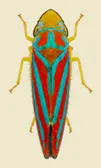
Similarly small and brightly marked, but has fixed blue-green wings crossed by bold orange-red bands rather than the variable coppery, brown or green coloring of the Coppery leafhopper.
Shares the wedge-shaped body and sap-feeding habit, but has a more elongated, pointed head rather than the broad, blunt head of the Coppery leafhopper.
Questions
Is the Coppery leafhopper dangerous to people?
Harmless to people; it feeds only on plant sap and does not bite or sting.
When can you see the Coppery leafhopper?
The Coppery leafhopper can be seen from May to October, by day.
Plate retouched from a photo by Trevor Edmonson, CC BY 4.0, iNaturalist Licence
Report a mistake in this entry
True bugs›Leafhoppers›Jikradia
Last updated 2026-09-27. Every entry is checked against published sources.