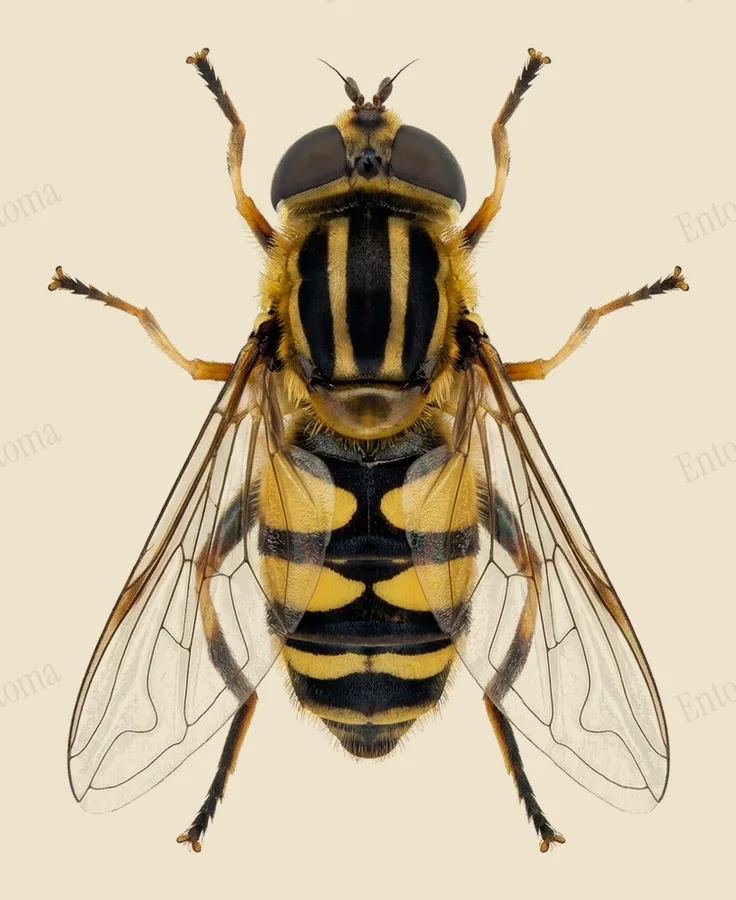
Narrow-headed marsh fly
Despite its bee-like yellow and black stripes, this hoverfly cannot sting, and its larvae develop instead in wet manure and rotting vegetation at the edges of ponds.
| Where | Ponds, marshes and manure-rich wetlands |
|---|---|
| Size | 10 to 16 mm long (body length) |
| When | March to June and August to November |
The Narrow-headed marsh fly is a medium-sized hoverfly, 10 to 16 mm long, with a black thorax marked by pale longitudinal stripes and an abdomen banded in black and lemon yellow. Males have a narrower head than females, and the legs are mostly yellow with dark brown markings.
Adults visit flowers for nectar and pollen and are common pollinators through much of the growing season. Larvae develop in wet, decaying organic matter such as pond-edge vegetation, mud and manure, an unappealing home that keeps most predators away.
Traits
Habitat
Wetland
Colour
Black, Yellow
Active
Day
To people
Harmless to people; it mimics a bee but cannot sting.
Activity through the year
Often confused with
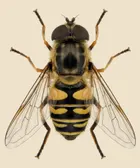
Shows a black, X-shaped mark on the abdomen outlined in bright yellow and crosswise stripes on the thorax, while the Narrow-headed marsh fly has plain lengthwise stripes on the thorax.
Questions
Is the Narrow-headed marsh fly dangerous to people?
Harmless to people; it mimics a bee but cannot sting.
When can you see the Narrow-headed marsh fly?
The Narrow-headed marsh fly can be seen from March to June and August to November, by day.
Plate retouched from a photo by Peter Chen 2.0, CC BY 4.0, iNaturalist Licence
Report a mistake in this entry
Last updated 2026-09-27. Every entry is checked against published sources.