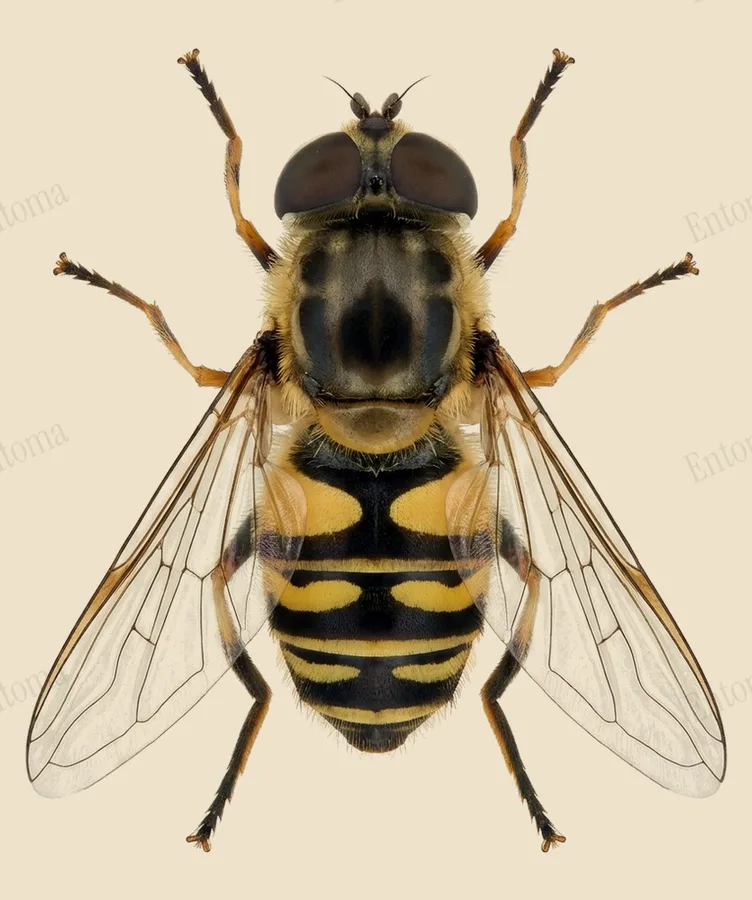
Transverse-banded flower fly
This fly wears a bright yellow scutellum and bicolored thorax that no honeybee has, yet its buzzing flight and shape still fool most predators.
| Where | Flowering plants in open, sunny habitats |
|---|---|
| Size | 7 to 12 mm body length |
| When | May to November |
The Transverse-banded flower fly has a thorax that is grey on the front half and black on the rear half, a bright yellow scutellum, and large yellow triangular patches on the abdomen. The pattern and buzzing flight closely resemble a honeybee, though it has only one pair of wings and no sting.
Adults visit flowers in open, sunny habitats to feed on nectar and pollen and hover almost motionless before darting away. Like other Eristalis flower flies, the larvae likely develop in stagnant, organic-rich water, though this species' own larval habits remain undocumented.
Traits
Habitat
Garden
Colour
Yellow, Black, Grey
Active
Day
To people
Feeds only on nectar and pollen; has no sting and does not bite people.
Activity through the year
Often confused with
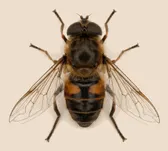
A stockier, darkish brown fly with orange-yellow patches, lacking the bicolored grey and black thorax and bright yellow scutellum that mark the Transverse-banded flower fly.
Questions
Is the Transverse-banded flower fly dangerous to people?
Feeds only on nectar and pollen; has no sting and does not bite people.
When can you see the Transverse-banded flower fly?
The Transverse-banded flower fly can be seen from May to November, by day.
Plate retouched from a photo by Bernie Paquette, CC BY 4.0, iNaturalist Licence
Report a mistake in this entry
Last updated 2026-09-26. Every entry is checked against published sources.