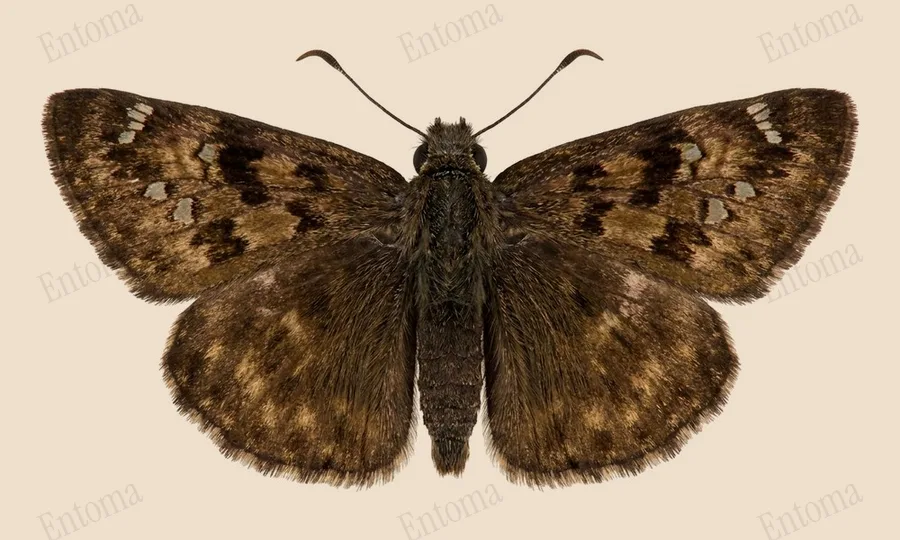
Horace's duskywing
After May, a single white spot in the forewing cell is the only reliable way to tell this skipper apart from its early spring look-alike.
| Where | Oak woodlands, brushy fields and roadsides |
|---|---|
| Size | 30 to 38 mm wingspan |
| When | April to October |
Horace's duskywing is a brown skipper with white flecked spots across the forewing, including a white spot in the forewing cell that is larger on females, and males show a bold white line above the eye. It rests with wings spread flat rather than held upright.
Caterpillars feed only on oak leaves, while adults visit buttonbush, dogbane, goldenrod and mud puddles for moisture and nutrients. Multiple broods fly from spring through autumn, making this one of the most frequently seen duskywings in forest clearings and brushy fields.
Traits
Habitat
Woodland
Colour
Brown, White
Active
Day
To people
Visits mud puddles and garden flowers; does not bite or sting people.
Activity through the year
Often confused with
Shows two pale spots near the leading edge of the ventral hindwing that Horace's duskywing lacks, and flies only in spring while Horace's duskywing continues into autumn.
Questions
Is the Horace's duskywing dangerous to people?
Visits mud puddles and garden flowers; does not bite or sting people.
When can you see the Horace's duskywing?
The Horace's duskywing can be seen from April to October, by day.
Plate retouched from a photo by Michael Newlon, CC BY 4.0, iNaturalist Licence
Report a mistake in this entry
Butterflies and moths›Skippers›Erynnis
Last updated 2026-09-26. Every entry is checked against published sources.