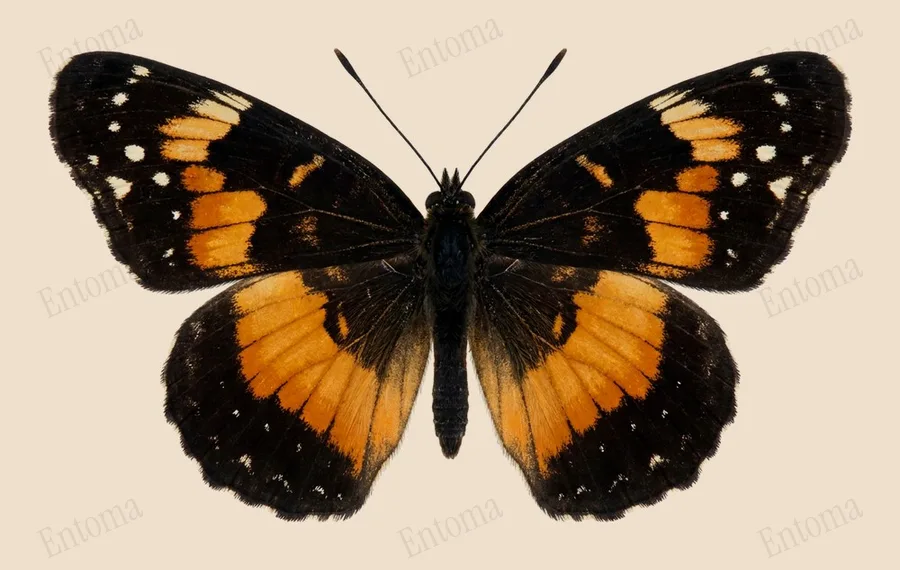
Bordered patch
This butterfly's black wings are so variably spotted that two Bordered patches from the same brood can look like different species.
| Where | Sunflower fields, mesquite scrub and roadsides |
|---|---|
| Size | 32 to 51 mm wingspan |
| When | March to November |
The Bordered patch is a black butterfly crossed with rows of white or yellow-orange spots that vary enormously between individuals, from almost solid black to broadly marked with red or pale bands. Despite this variation, nearly every individual carries one small red spot near the inner corner of the hindwing, the most consistent mark in the whole species.
Young caterpillars feed together on sunflowers and ragweed, skeletonizing whole leaves before scattering to feed alone as they grow larger. Several generations can follow one another through a single warm season across the southern part of the range.
Traits
Habitat
Farmland
Colour
Black, Orange, White
Active
Day
To people
Feeds on flower nectar; harmless to people, though its caterpillars can strip leaves from garden sunflowers.
Activity through the year
Often confused with
Larger overall and marked with two spots in the forewing cell rather than the single whitish spot typical of the Bordered patch, with a yellow basal patch on the underside of the hindwing.
Questions
Is the Bordered patch dangerous to people?
Feeds on flower nectar; harmless to people, though its caterpillars can strip leaves from garden sunflowers.
When can you see the Bordered patch?
The Bordered patch can be seen from March to November, by day.
Plate retouched from a photo by Yael Ruiz, CC BY‑SA 4.0, iNaturalist Licence
The plate on this page is shared under the same licence as its source, CC BY-SA.
Report a mistake in this entry
Butterflies and moths›Brush-footed butterflies›Chlosyne
Last updated 2026-09-27. Every entry is checked against published sources.