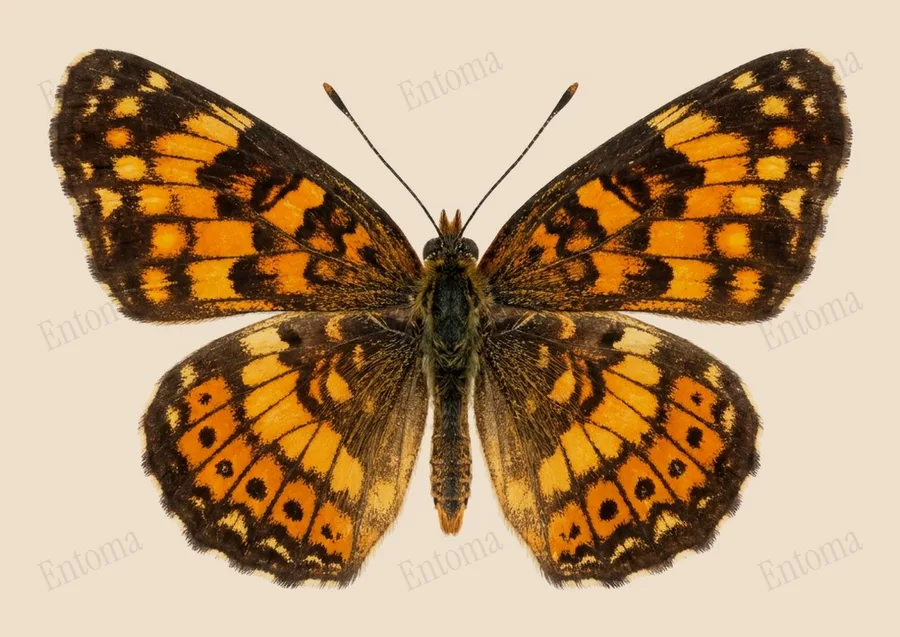
Silvery checkerspot
Young caterpillars of this butterfly feed side by side in silk-lined groups, skeletonizing leaves together before scattering to live alone as they mature.
| Where | Streamsides, meadows and forest openings |
|---|---|
| Size | 35 to 51 mm wingspan |
| When | April to September |
The Silvery checkerspot has pale yellow-orange upperwings crossed with dark borders and markings, while the underside of the hindwing is pale with white-centered spots and a broad white crescent near the margin. Its short front legs and longer back legs can make it look four-legged when perched.
Caterpillars feed on black-eyed Susan, asters and related plants, living gregariously while young and overwintering as partly grown larvae. One brood flies in the north each year, with two broods common through most of the range.
Traits
Habitat
Wetland
Colour
Orange, Black, White
Active
Day
To people
Feeds on flower nectar; harmless to people.
Activity through the year
Often confused with
Similar in size and color, but Harris's checkerspot shows heavier black borders on the upperside and a single red-orange stripe on the underside of the hindwing, a pattern the Silvery checkerspot lacks.
Questions
Is the Silvery checkerspot dangerous to people?
Feeds on flower nectar; harmless to people.
When can you see the Silvery checkerspot?
The Silvery checkerspot can be seen from April to September, by day.
Plate retouched from a photo by aarongunnar, CC BY 4.0, iNaturalist Licence
Report a mistake in this entry
Butterflies and moths›Brush-footed butterflies›Chlosyne
Last updated 2026-09-27. Every entry is checked against published sources.