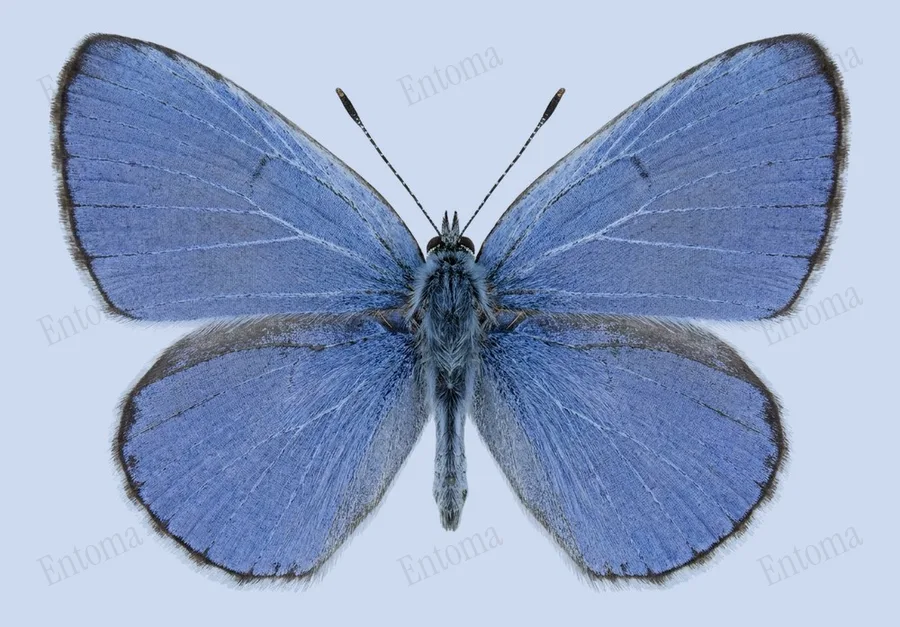
Echo azure
Its caterpillars carry a gland near the tail that oozes a sugary liquid, and ants that drink it in return guard the caterpillars from predators.
| Where | Woodland edges, streamsides and shrubby foothills |
|---|---|
| Size | 19 to 35 mm wingspan |
| When | March to July |
The Echo azure is a small butterfly with a wingspan of about 19 to 35 mm. Males are lilac-blue above with no dark markings, while females are dusky blue with a scattering of black marginal spots; the underside of both sexes is pale grey-white marked with fine black chevrons and bars.
Caterpillars feed on the flower buds and young fruit of shrubs such as chokecherry, dogwood, ceanothus and oceanspray. A gland near the tail produces a sugary secretion that ants drink in exchange for guarding the caterpillar from predators. The chrysalis overwinters before adults emerge in spring.
Traits
Habitat
Woodland
Colour
Blue, Grey
Active
Day
To people
Harmless to people; it does not bite or sting.
Activity through the year
Often confused with
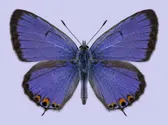
Carries a single thread-like tail on each hindwing and a pair of black spots capped with orange near it, marks the Echo azure lacks entirely.
Questions
Is the Echo azure dangerous to people?
Harmless to people; it does not bite or sting.
When can you see the Echo azure?
The Echo azure can be seen from March to July, by day.
Plate retouched from a photo by John Hibbard, CC BY 4.0, iNaturalist Licence
Report a mistake in this entry
Butterflies and moths›Blues and coppers›Celastrina
Last updated 2026-09-27. Every entry is checked against published sources.