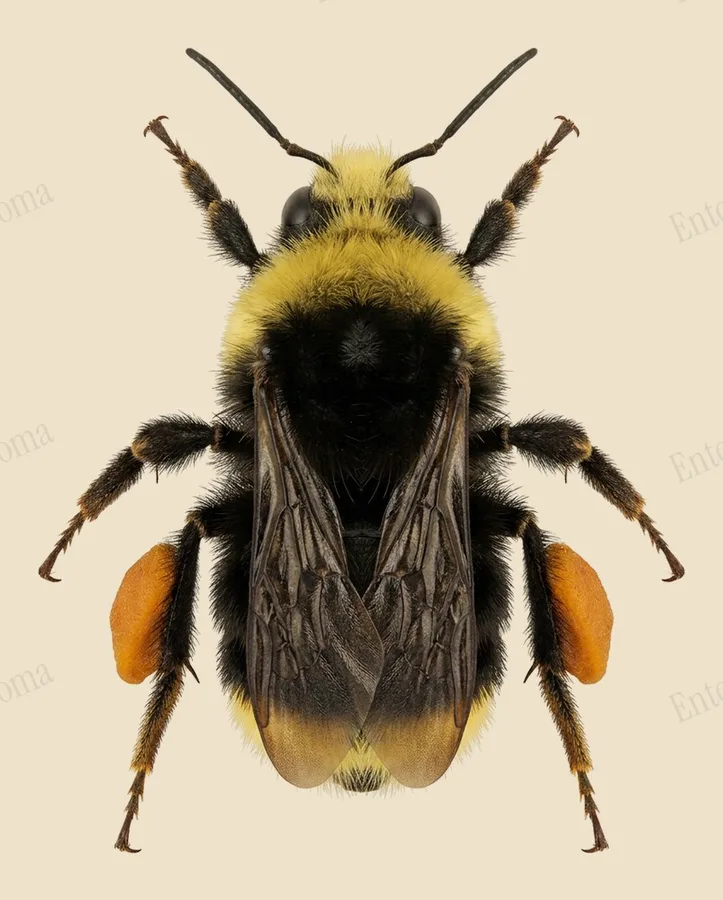
Yellow-faced bumble bee
Yellow-faced bumble bee colonies begin each spring with one queen who survived winter alone underground, often in an abandoned rodent burrow, before founding a nest by herself.
| Where | Pacific coast gardens, meadows and scrub |
|---|---|
| Size | 8 to 21 mm body length |
| When | March to September |
The Yellow-faced bumble bee has a square yellow patch on its face that gives the species its name, along with a black thorax marked by yellow stripes near the head and midsection and a black and yellow banded abdomen.
Queens emerge from hibernation as early as December in the mildest parts of the range and search out old rodent burrows or similar cavities to start a nest alone, while workers stay active from spring through fall gathering pollen and nectar across gardens, parks, meadows and coastal scrub.
Traits
Habitat
Garden
Colour
Black, Yellow
Active
Day
To people
Take care
Stings only when handled or its nest is disturbed; the sting is painful but not dangerous to most people.
Activity through the year
Often confused with
The obscure bumble bee has yellow hairs on the underside of its abdomen and a longer face, while the yellow-faced bumble bee's abdomen is black underneath and its face is comparatively short.
Questions
Is the Yellow-faced bumble bee dangerous to people?
Take care. Stings only when handled or its nest is disturbed; the sting is painful but not dangerous to most people.
When can you see the Yellow-faced bumble bee?
The Yellow-faced bumble bee can be seen from March to September, by day.
Plate retouched from a photo by LJ Moore-McClelland, CC BY 4.0, iNaturalist Licence
Report a mistake in this entry
Bees, wasps and ants›Bees and bumblebees›Bombus
Last updated 2026-09-26. Every entry is checked against published sources.