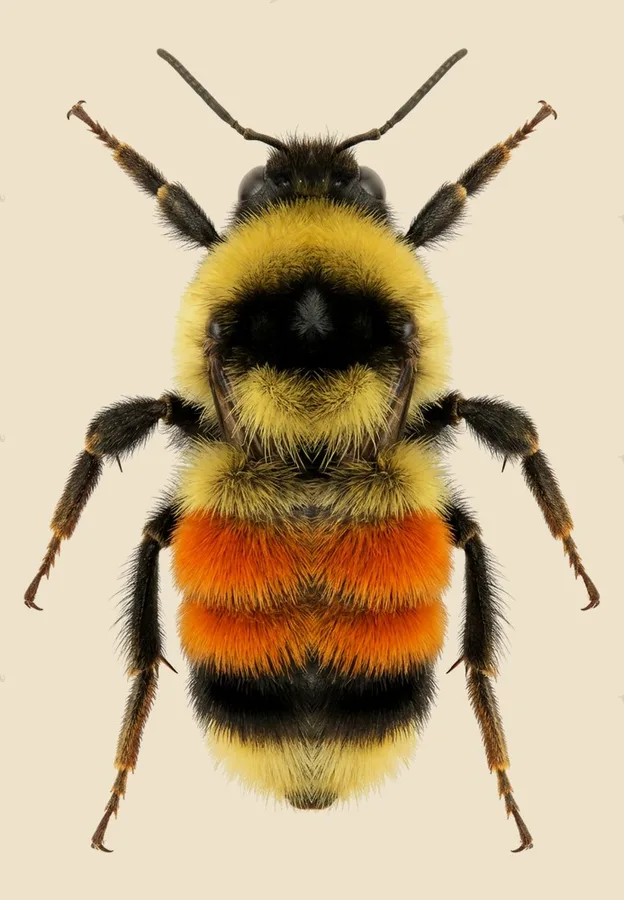
Tricolored bumble bee
Colonies rarely grow past two hundred workers, and unlike honeybees this species can sting repeatedly because its stinger has no barb to catch in skin.
| Where | Meadows, gardens and northern forest edges |
|---|---|
| Size | 8 to 19 mm body length |
| When | May to October |
The Tricolored bumble bee is a small, slender bumble bee with a yellow thorax, an orange band across the second and third abdominal segments, and black hind segments, a pattern that separates it from most other bumble bees sharing its range.
Queens found small, short lived colonies each spring in ground nests, and workers forage on a wide variety of flowers through meadows, gardens, and forest edges from spring into autumn.
Traits
Habitat
Grassland
Colour
Orange, Yellow, Black
Active
Day
To people
Mild
Not aggressive and rarely stings unless its nest is handled or threatened.
Activity through the year
Often confused with
Often shows red hairs mixed with black on the first abdominal segment and lacks the solid black shield shaped patch on the thorax that marks the Tricolored bumble bee.
Questions
Is the Tricolored bumble bee dangerous to people?
Mild. Not aggressive and rarely stings unless its nest is handled or threatened.
When can you see the Tricolored bumble bee?
The Tricolored bumble bee can be seen from May to October, by day.
Plate retouched from a photo by raffib128, CC0, iNaturalist Licence
Report a mistake in this entry
Bees, wasps and ants›Bees and bumblebees›Bombus
Last updated 2026-09-26. Every entry is checked against published sources.