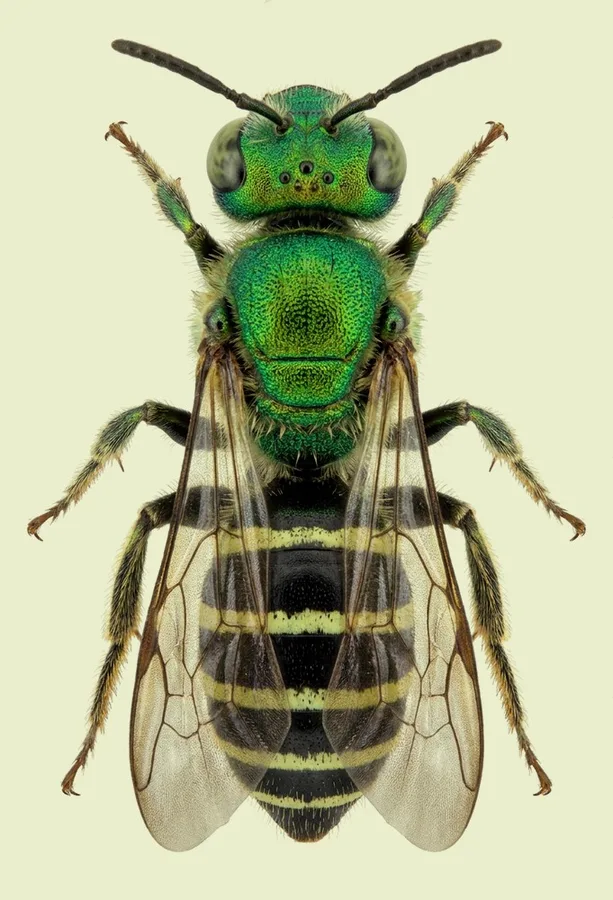
Bicolored striped sweat bee
Male Bicolored striped sweat bees have black-and-yellow striped abdomens, while females combine a metallic green head and thorax with a black-and-white striped abdomen.
| Where | Sunny bare ground and gardens |
|---|---|
| Size | 10 to 13 mm body length |
| When | May to October |
The Bicolored striped sweat bee is a shiny, metallic green bee about 10 to 13 mm long. Females have a black abdomen banded with white hair, while males show black and yellow stripes on the abdomen below a matching green thorax.
Females dig nest tunnels in sunny, bare or thinly vegetated ground, sometimes sharing one entrance among several unrelated females who each provision their own brood cells with pollen and nectar. It visits a wide variety of flowers, and, like other bees, only a female can sting, which she rarely does unless handled or trapped against the skin.
Traits
Habitat
Garden
Colour
Green, Black, Yellow
Active
Day
To people
Mild
Only females can sting, and they rarely do; this bee is gentle and stings only if trapped or handled roughly.
Activity through the year
Often confused with
Females are entirely metallic green with silvery abdominal bands and a rough, sandpaper-textured thorax, unlike the black-and-white striped abdomen of the Bicolored striped sweat bee.
Questions
Is the Bicolored striped sweat bee dangerous to people?
Mild. Only females can sting, and they rarely do; this bee is gentle and stings only if trapped or handled roughly.
When can you see the Bicolored striped sweat bee?
The Bicolored striped sweat bee can be seen from May to October, by day.
Plate retouched from a photo by aswad, CC0, iNaturalist Licence
Report a mistake in this entry
Bees, wasps and ants›Sweat bees›Agapostemon
Last updated 2026-09-27. Every entry is checked against published sources.