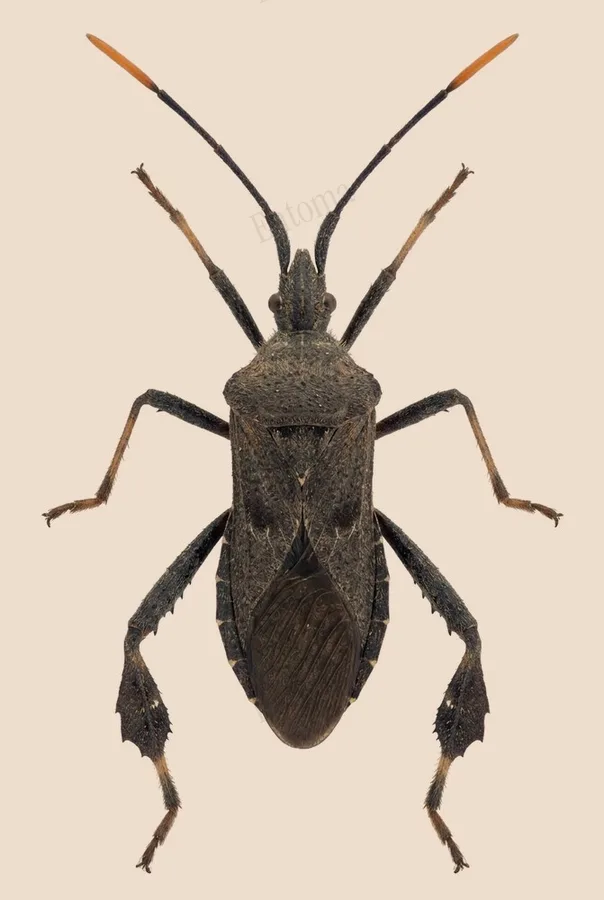
Leaf-footed bug
This leaf footed bug's defensive scent can still be smelled on human skin hours after handling it, even though the insect does not bite or sting.
| Where | Woodland edges and shrubby fields |
|---|---|
| Size | 19 to 25 mm body length |
| When | April to October |
Adults are dark gray to black bugs about 19 to 25 mm long, with flattened, leaf like expansions on the hind legs and the last segment of each antenna tipped in orange. They are usually seen alone rather than in groups.
Nymphs and adults feed by piercing stems, leaves and fruit of shrubs and trees such as sumac, wild grape and ninebark to drink plant sap. Adults overwinter in sheltered spots and become active again in spring.
Traits
Habitat
Woodland
Colour
Black, Grey, Orange
Active
Day
To people
Produces a strong, long lasting defensive odor if handled, but is not known to bite or sting people.
Activity through the year
Often confused with
A similarly dark, leaf-footed bug of overlapping size, but marked with a pale zigzag band across the closed wings, a pattern this species lacks.
Questions
Is the Leaf-footed bug dangerous to people?
Produces a strong, long lasting defensive odor if handled, but is not known to bite or sting people.
When can you see the Leaf-footed bug?
The Leaf-footed bug can be seen from April to October, by day.
Plate retouched from a photo by davidfbird, CC0, iNaturalist Licence
Report a mistake in this entry
True bugs›Leaf-footed bugs›Acanthocephala
Last updated 2026-09-26. Every entry is checked against published sources.