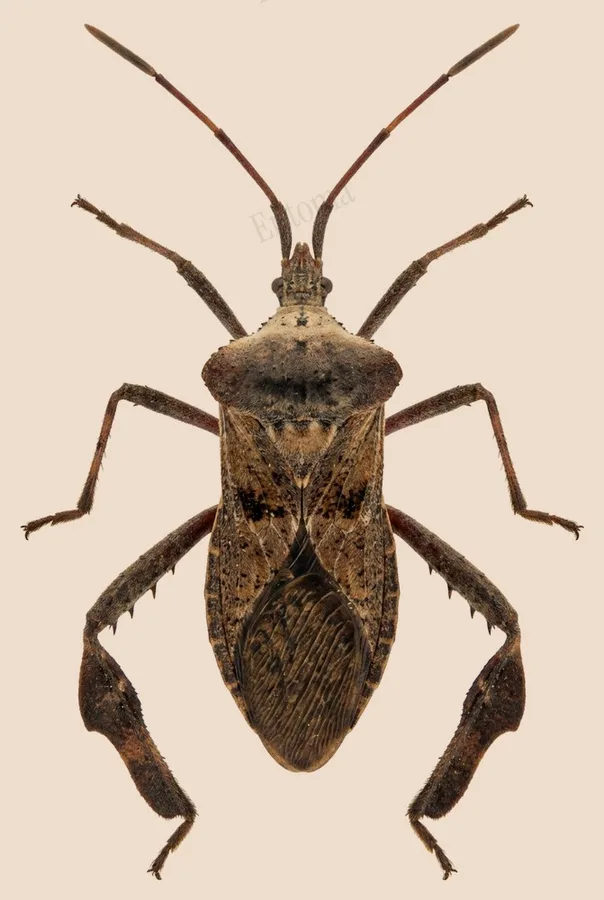
Giant leaf-footed bug
Male Giant leaf-footed bugs carry enlarged, leaf-shaped hind legs that they use to grapple rival males, while females keep slender, ordinary legs.
| Where | Trees, shrubs and woodland edges |
|---|---|
| Size | 28 to 34 mm body length |
| When | January to December |
The Giant leaf-footed bug is the largest member of its genus in its range, with a broadly flared pronotum that extends well past the abdomen and blunt bumps along its front edge. Males stand out for their swollen, leaf-shaped hind legs, used in bouts with rival males and in courting females, while females have plain, slender legs.
Like other leaf-footed bugs, it feeds only on plant sap and does not bite people; a closely related species in the same genus is documented as unable to pierce human skin even when handled roughly.
Traits
Habitat
Woodland
Colour
Brown
Active
Day
To people
Safe to handle; it does not bite people.
Activity through the year
Often confused with
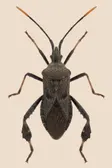
Smaller, usually 18 to 25 mm long, and lacking the blunt bumps on the front edge of the pronotum found on the Giant leaf-footed bug.
Questions
Is the Giant leaf-footed bug dangerous to people?
Safe to handle; it does not bite people.
When can you see the Giant leaf-footed bug?
The Giant leaf-footed bug can be seen from January to December, by day.
Plate retouched from a photo by Robert Hoard, CC BY 4.0, iNaturalist Licence
Report a mistake in this entry
True bugs›Leaf-footed bugs›Acanthocephala
Last updated 2026-09-27. Every entry is checked against published sources.