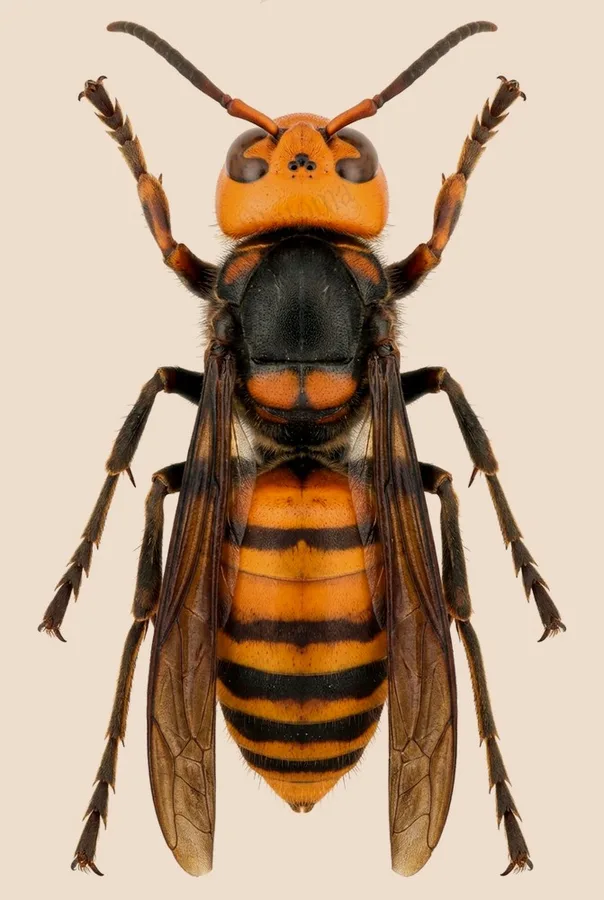
Asian giant hornet
A raiding party of only a few dozen hornets can destroy an entire honeybee colony within hours, decapitating adult bees to feed their thoraxes to hornet larvae.
| Where | Forests across Japan and East Asia |
|---|---|
| Size | 26 to 45 mm body length |
| When | May to November |
The Asian giant hornet is the largest hornet in the world, with a broad orange-yellow head, large dark eyes, and a brown and orange banded abdomen. Workers reach up to 45 millimetres long, and queens can be larger still.
Colonies are founded by a single queen each spring, usually in an underground cavity or hollow tree, and grow through summer into large nests of workers that hunt other insects and raid honeybee colonies for food. It is found in forests and forest edges across Japan and East Asia.
Traits
Habitat
Woodland
Colour
Orange, Brown, Black
Active
Day
To people
Dangerous
Only females can sting; the sting causes severe pain and swelling, and Japan records an estimated 30 to 50 hornet-sting deaths a year, mostly from disturbed nests or allergic reactions.
Activity through the year
Often confused with
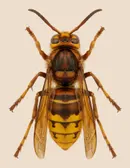
Distinctly smaller in every caste, since the Asian giant hornet is recognized as the world's largest hornet, and it lacks the giant hornet's uniformly broad orange-yellow head.
Questions
Is the Asian giant hornet dangerous to people?
Dangerous. Only females can sting; the sting causes severe pain and swelling, and Japan records an estimated 30 to 50 hornet-sting deaths a year, mostly from disturbed nests or allergic reactions.
When can you see the Asian giant hornet?
The Asian giant hornet can be seen from May to November, by day.
Plate retouched from a photo by WATANABE Hitoshi 渡辺仁, CC BY 4.0, iNaturalist Licence
Report a mistake in this entry
Bees, wasps and ants›Wasps and hornets›Vespa
Last updated 2026-09-27. Every entry is checked against published sources.