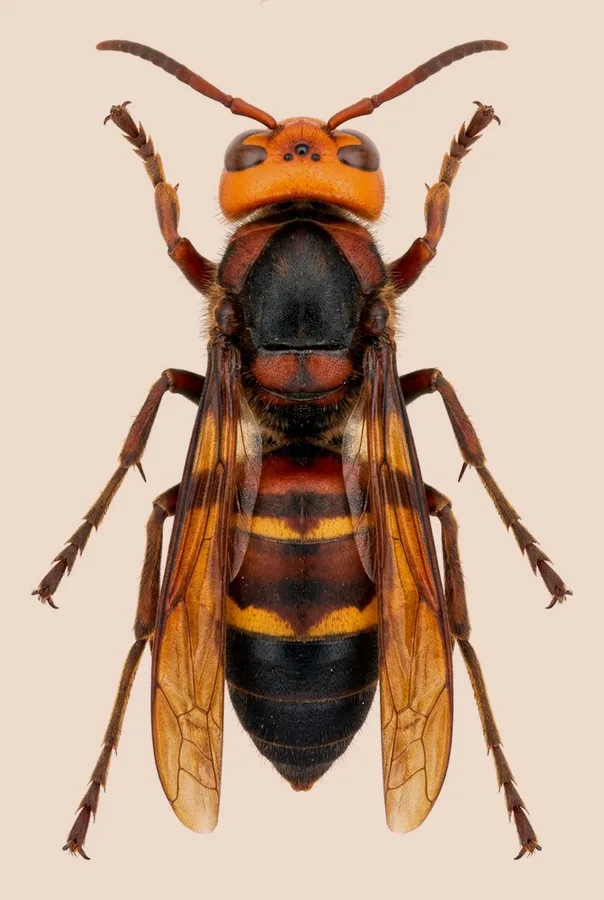
Black-tailed hornet
The Black-tailed hornet raids the nests of paper wasps for their grubs, brushing past the adult guards to reach the brood rather than fighting them.
| Where | Forests with tree hollows and ground cavities |
|---|---|
| Size | 24 to 38 mm body length |
| When | April to October |
The Black-tailed hornet has a pale yellow brown head, a dark brown thorax and a dark abdomen banded with orange yellow near the base and gold at the tip, a pattern that separates it from the wholly black bellied hornets sharing its range.
Colonies are small compared with other hornets and nest in tree hollows or existing ground cavities. Adults specialise in hunting paper wasp larvae and pupae straight from wasp combs, usually ignoring the adult wasps guarding them.
Traits
Habitat
Woodland
Colour
Orange, Brown, Black
Active
Day
To people
Take care
Only females can sting; the venom is potent and causes real pain and swelling, though this hornet is generally not aggressive and rarely attacks unless its nest is handled or disturbed.
Activity through the year
Often confused with
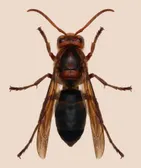
Black-bellied hornet has a reddish brown head and a wholly black abdomen, while the Black-tailed hornet has a paler head and an abdomen banded with orange yellow and gold.
Questions
Is the Black-tailed hornet dangerous to people?
Take care. Only females can sting; the venom is potent and causes real pain and swelling, though this hornet is generally not aggressive and rarely attacks unless its nest is handled or disturbed.
When can you see the Black-tailed hornet?
The Black-tailed hornet can be seen from April to October, by day.
Plate retouched from a photo by Min-Hsuan NI, CC BY 4.0, iNaturalist Licence
Report a mistake in this entry
Bees, wasps and ants›Wasps and hornets›Vespa
Last updated 2026-09-27. Every entry is checked against published sources.