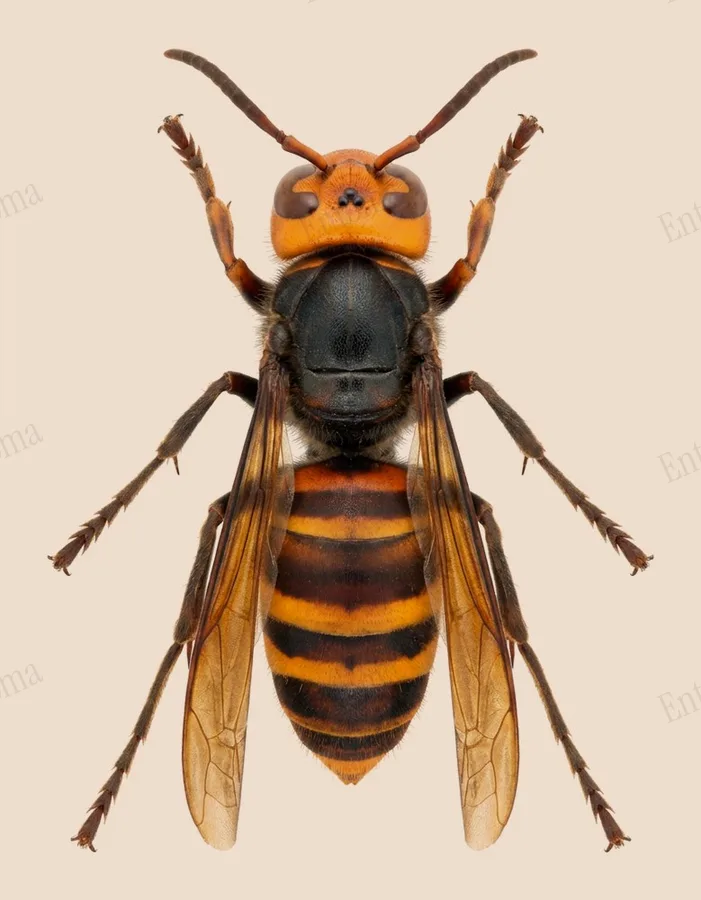
Yellow-vented hornet
Workers defend the nest by biting with their mandibles as well as stinging, and colonies are sometimes raided and wiped out by larger hornet species.
| Where | Forests and towns across East Asia |
|---|---|
| Size | 22 to 30 mm body length |
| When | May to November |
This hornet has a dark orange and black banded body with black legs, and the tip of the abdomen is bright yellow, which gives the species its name. The look-alike Yellow hornet is more evenly yellow overall, with yellow legs and a yellow scutellum where this species is dark.
Colonies build paper nests that often hang from a thin branch, wire or house eave rather than sitting in a large open cavity, and can grow to roughly twenty to ninety workers by autumn. Workers hunt other insects to feed the larvae and become markedly more defensive once the nest is established.
Traits
Habitat
Woodland
Colour
Black, Orange
Active
Day
To people
Take care
Females can sting repeatedly in defence of the nest, and the sting is painful.
Activity through the year
Often confused with
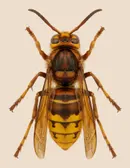
More evenly yellow overall, with yellow legs and a yellow scutellum, where the Yellow-vented hornet has black legs and darker orange-black banding.
Questions
Is the Yellow-vented hornet dangerous to people?
Take care. Females can sting repeatedly in defence of the nest, and the sting is painful.
When can you see the Yellow-vented hornet?
The Yellow-vented hornet can be seen from May to November, by day.
Plate retouched from a photo by ITÔ, Hiroki, CC BY 4.0, iNaturalist Licence
Report a mistake in this entry
Bees, wasps and ants›Wasps and hornets›Vespa
Last updated 2026-09-27. Every entry is checked against published sources.