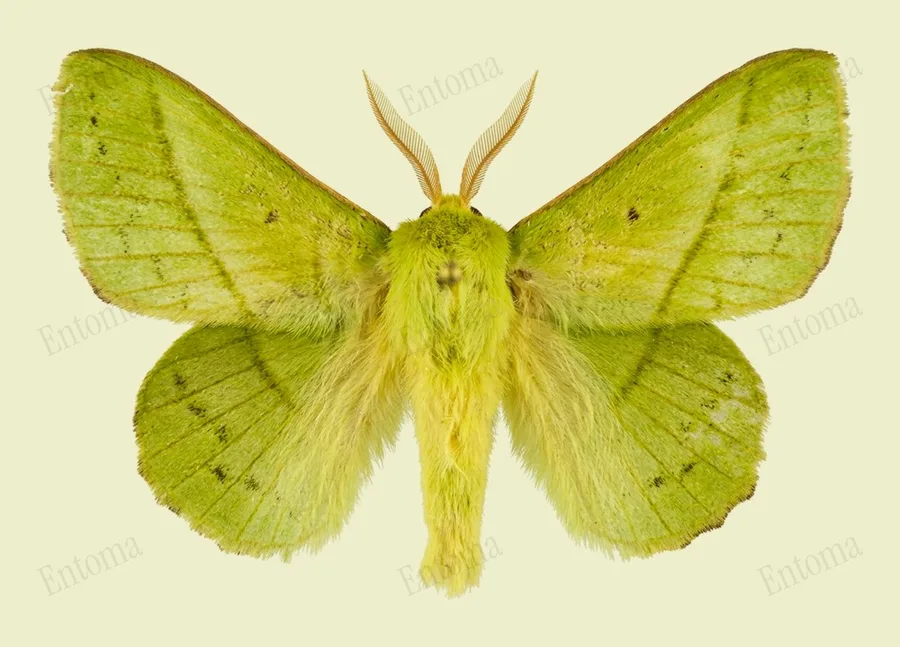
Rose myrtle lappet moth
A freshly spun Rose myrtle lappet moth cocoon keeps stinging caterpillar hairs woven into its silk, so the pupa stays defended long after the hairs left living skin.
| Where | Woodland edges, orchards and gardens |
|---|---|
| Size | 47 to 67 mm wingspan |
| When | January to December |
Males are apple green with a whitish disc on each forewing, while females are larger and yellowish green fading to ochre, with an enlarged, dark, scale dusted spot near the centre of each forewing.
Caterpillars feed on a very wide range of trees and shrubs, including rose, tea, guava and pomegranate, and carry dense tufts of hairs that irritate skin on contact and remain on the finished cocoon.
Traits
Habitat
Garden
Colour
Green, Yellow, Brown
Active
Night
To people
Take care
Caterpillars carry hairs that irritate skin on contact; avoid handling them bare handed.
Activity through the year
Often confused with
Its wing postmedial line curves near the costa with a dark fringe, and the female's reddish brown medial patch sits centred on the forewing, unlike the browner, more marginal patch of the Rose myrtle lappet moth.
Questions
Is the Rose myrtle lappet moth dangerous to people?
Take care. Caterpillars carry hairs that irritate skin on contact; avoid handling them bare handed.
When can you see the Rose myrtle lappet moth?
The Rose myrtle lappet moth can be seen from January to December, at night.
Plate retouched from a museum specimen photo by Taiwan Biodiversity Research Institute, CC BY 4.0, GBIF Licence
Report a mistake in this entry
Butterflies and moths›Lappet moths›Trabala
Last updated 2026-09-27. Every entry is checked against published sources.