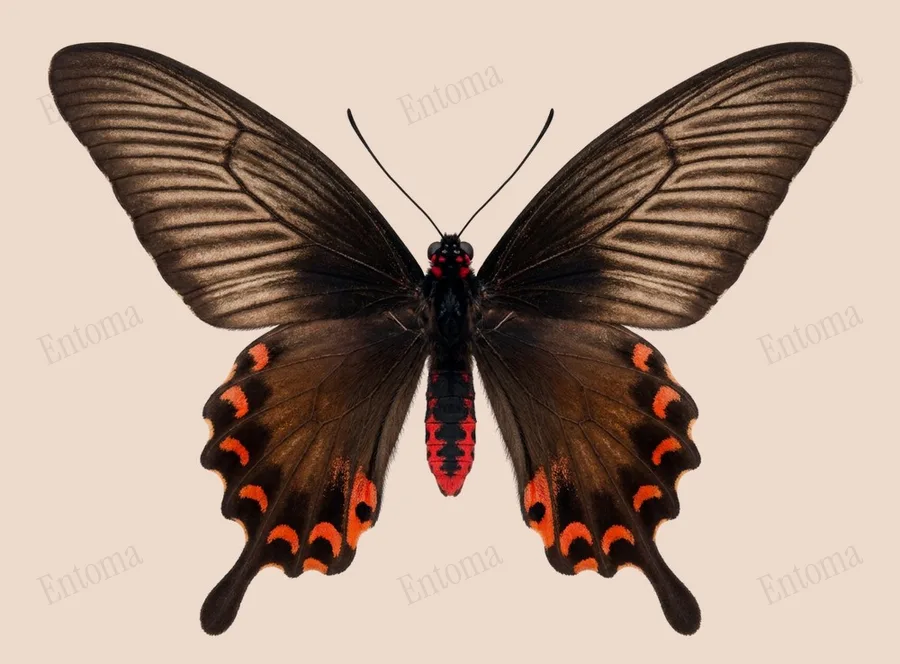
Chinese windmill
This swallowtail stores toxic aristolochic acid from its caterpillar food plant throughout its life, including a dose in the fluid its larvae spray at attacking predators.
| Where | Broadleaf forests across Japan and East Asia |
|---|---|
| Size | 90 to 100 mm wingspan |
| When | March to October |
The Chinese windmill is a large swallowtail with black or dark brown wings spanning 90 to 100 millimetres. Long tails extend from the hindwings, which carry a chain of red spots along the outer margin, and the body shows red markings against black.
Caterpillars feed only on Aristolochia vines and store the plants' toxic aristolochic acid in their tissues through to the adult stage, a defense that makes the butterfly unpalatable to birds. It overwinters as a pupa and flies through broadleaf forest across Japan, Korea, China, and Taiwan.
Traits
Habitat
Woodland
Colour
Black, Red
Active
Day
To people
Mild
Not known to sting or bite, but its tissues contain aristolochic acid, so it should never be eaten or handled carelessly around the mouth.
Activity through the year
Often confused with
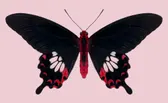
Its hindwing carries bold white patches between the veins and bright, unobscured red spots, markings absent from the plain dark hindwing of the Chinese windmill.
Questions
Is the Chinese windmill dangerous to people?
Mild. Not known to sting or bite, but its tissues contain aristolochic acid, so it should never be eaten or handled carelessly around the mouth.
When can you see the Chinese windmill?
The Chinese windmill can be seen from March to October, by day.
Plate retouched from a museum specimen photo by Frans Slieker, Natural History Museum Rotterdam, CC BY 4.0, GBIF Licence
Report a mistake in this entry
Butterflies and moths›Swallowtails›Byasa
Last updated 2026-09-27. Every entry is checked against published sources.