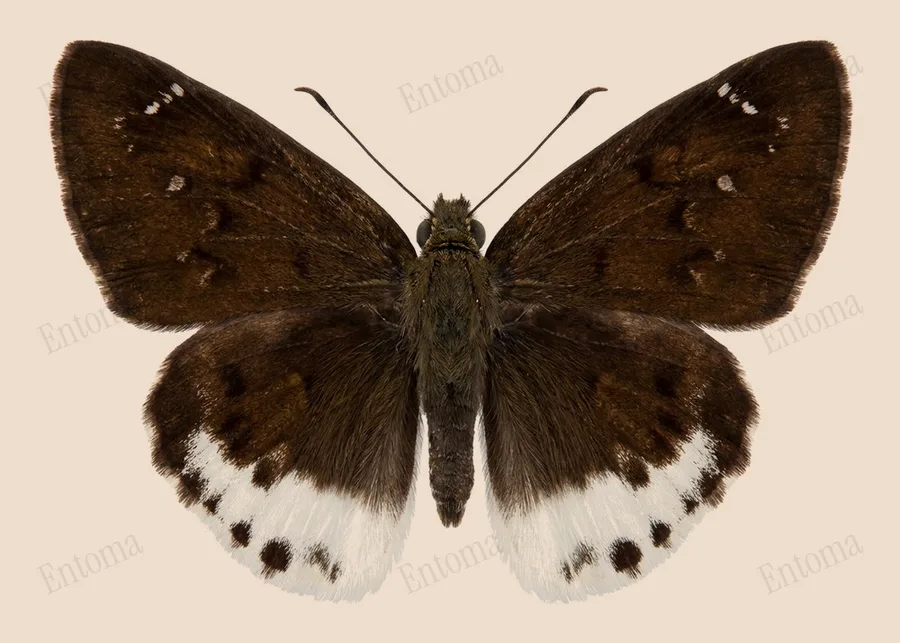
White-banded flat
This skipper rests upside down beneath leaves and can be told from most relatives in the region by the broad white band crossing its dark hindwing.
| Where | Secondary forest across eastern Asia |
|---|---|
| Size | 15 to 21 mm forewing length |
| When | March to November |
The White-banded flat is a dark brown skipper with a broad white band crossing the hindwing, a mark shared by most Tagiades species in the region but absent in the closely related Common snow flat. It rests with wings spread flat, often on the underside of a leaf.
Caterpillars feed on yams and on Mongolian oak, rolling leaves into shelters as they grow. Adults fly fast and low through secondary forest, from lowland edges up to about 1,300 m.
Traits
Habitat
Woodland
Colour
Brown, White
Active
Day
To people
Harmless to people; does not bite or sting.
Activity through the year
Often confused with
Lacks the broad white hindwing band shown by most Tagiades in the region, including the White-banded flat, and is the only local species without it.
Questions
Is the White-banded flat dangerous to people?
Harmless to people; does not bite or sting.
When can you see the White-banded flat?
The White-banded flat can be seen from March to November, by day.
Plate retouched from a museum specimen photo by Swiss Natural History Collections - SwissNatColl, CC BY 4.0, GBIF Licence
Report a mistake in this entry
Butterflies and moths›Skippers›Tagiades
Last updated 2026-09-27. Every entry is checked against published sources.